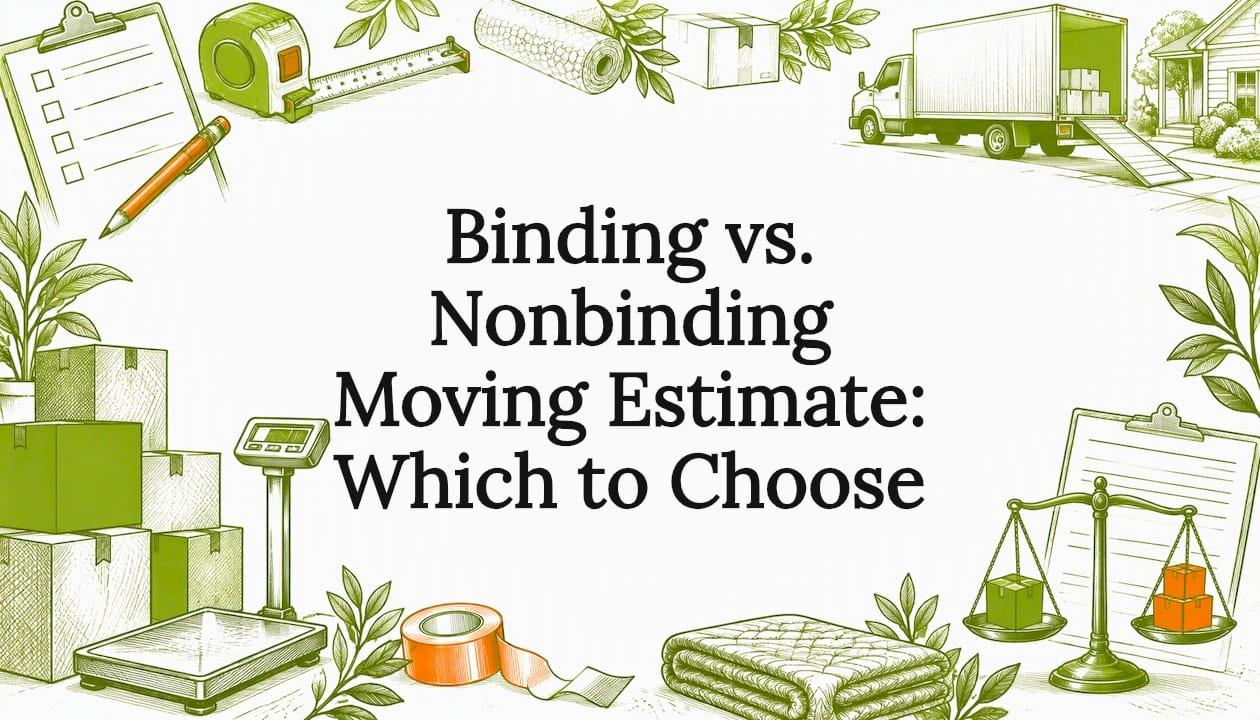
A binding estimate fixes the price of your move in writing, so you do not pay more at delivery for the goods and services listed. A nonbinding estimate is only the mover's best guess: the final bill depends on the actual weight of your shipment and the services performed. If your priority is a predictable total, ask for a binding estimate. If you take a nonbinding one, know the federal limits on what a mover can demand at delivery.
This guide explains both types in plain terms, shows the rules that protect you on an interstate move, walks through what can change a "locked" price, and gives you a checklist for reading any estimate before you sign.
TL;DR
- Binding estimate: the price is set in writing. Per the FMCSA, you do not have to pay more than the estimate at delivery.
- Nonbinding estimate: the final charge is based on actual weight, services provided and the mover's published tariff. It can come in higher or lower.
- The 110% rule: on an interstate move under a nonbinding estimate, the mover cannot require more than 110 percent of the estimate at delivery. The rest is billed later.
- A binding price can still be revised if you add items or services, or if conditions such as stairs, elevators or parking permits change the job.
- Get it in writing: verbal rates are not official estimates, and the document must say which type it is.
Table of Contents
- What a binding moving estimate means
- What a nonbinding estimate means
- Binding vs. nonbinding: side-by-side
- The third option: binding not-to-exceed
- How to choose the right estimate for your move
- What to check in a written estimate before you sign
- Red flags in moving estimates
- Our perspective
- Get a binding estimate for your move
- Steps to lock in the right estimate
- FAQ
- Sources
What a binding moving estimate means
A binding estimate is a written agreement that the mover will charge a set amount for the inventory and services described. The FMCSA explains that it guarantees you will not have to pay more than the estimated amount at delivery.
That guarantee depends on the document matching reality. The price is tied to the list of items, the services you requested (packing, long carries, appliance handling) and the access conditions the mover recorded. If your move matches what was written down, the number on moving day is the number you were quoted.
People searching for "binding estimate moving" usually want one answer: can the price go up? For the same inventory and services, no. That is why a binding estimate suits anyone working to a fixed budget, such as a family closing on a house with a tight cash plan.
What a binding estimate does not freeze
The price is fixed for the move as described. It is not fixed for a different move. Three situations commonly lead to a revision:
- You add items. An extra room of furniture, a piano or a storage unit's contents changes the shipment.
- You add services. Packing a kitchen you planned to pack yourself, or requesting unpacking, changes the scope.
- Conditions differ from what was recorded. According to the FMCSA, if you add items or services, or if circumstances such as stairs, elevators or required parking permits arise, the mover must prepare a new binding estimate.
Notice what is protected here: the mover cannot simply add the charge at the truck. A revised estimate has to be prepared. Ask the mover to tell you before moving day about every access issue at both addresses, so those surprises are already in the number.
What a nonbinding estimate means
A nonbinding estimate is the mover's approximation. The FMCSA states that it is not a guarantee of final costs: charges are based on the actual weight of your shipment, the services provided and the mover's published tariff.
In practice, the mover estimates your weight from a survey of your belongings, then weighs the loaded truck. If the shipment weighs more than estimated, you pay more. If it weighs less, you pay less. You do not know the exact total until your goods are weighed.

The 110 percent limit at delivery
Federal rules cap what a mover can require when it delivers. Under a nonbinding estimate, the company cannot require you to pay more than 110 percent of the estimate at delivery. The FMCSA handbook cites 49 CFR 375.407 for this rule and says any remaining charges are billed afterward, with payment due in 30 days.
Here is what that looks like with round numbers:
| Nonbinding estimate | Most the mover can require at delivery (110%) | If the final bill is $5,900 |
|---|---|---|
| $5,000 | $5,500 | Pay $5,500 at delivery; the remaining $400 is billed later, due in 30 days |
| $7,000 | $7,700 | Final bill under $7,700 is due in full at delivery |
These are illustrative numbers, not quotes. The cap applies to when the money is due, not to what you ultimately owe. A 110 percent limit does not make a low estimate a good deal: you still owe the full tariff-based charge for the weight and services.
For how this plays out on shorter hauls, see our guide on how to avoid a 110% surprise bill on small long-distance moves.
When the mover must release your goods
The FMCSA handbook also describes what you must pay to get possession of your shipment: 100 percent of a binding estimate, or 110 percent of a nonbinding estimate, plus 15 percent of any impracticable-operations charges if they apply. Those charges cover services that were needed because of difficult conditions at delivery, such as a truck that could not reach the door. They are due at delivery but cannot exceed 15 percent of all other charges due then, and the balance is billed with 30 days to pay.
Binding vs. nonbinding: side-by-side
| Question | Binding estimate | Nonbinding estimate |
|---|---|---|
| Is the price fixed? | Yes, for the inventory and services listed | No, it depends on actual weight and services |
| Can the final bill be higher? | Only if you add items or services, or conditions change and a new estimate is prepared | Yes, based on weight, services and tariff |
| Maximum due at delivery | 100% of the estimate | 110% of the estimate on interstate moves |
| Can the final bill be lower? | Not under a plain binding estimate | Yes, if the shipment weighs less |
| Best for | Fixed budgets and people who want certainty | Moves where the load is hard to predict |
The third option: binding not-to-exceed
Many movers and moving guides describe a hybrid called a binding not-to-exceed estimate. The idea is that the price will not go above the written figure, but could come in lower if your shipment weighs less or you use fewer services than projected. Wheaton's consumer guide on interstate moving laws lists binding, nonbinding and binding-not-to-exceed as the main types.
Because this label is an industry term, do not rely on the name alone. Federal rules call for the estimate document to state whether it is binding or nonbinding on its face, so ask the mover to show you exactly how the not-to-exceed terms are written, and whether the lower-weight adjustment is spelled out. If the paperwork says "binding," you know the $ figure you have to pay at delivery.
How to choose the right estimate for your move
There is no universal winner, but a few questions settle it quickly.
- How firm is your budget? If a surprise of several hundred or a few thousand dollars would cause real trouble, choose binding.
- How well can your inventory be predicted? A one-bedroom apartment with a documented inventory is easier to price firmly than a house with a garage and storage unit you have not sorted.
- How likely are you to add or remove items? If you are still deciding what to sell or donate, wait until your inventory is final before you lock a binding price, so you are not revising it later.
- Are there access issues? Stairs, elevators, long carries between the truck and the door, and parking permits all affect cost. Disclose them at the survey.
- Is the quote suspiciously low? A nonbinding figure far below the others can mean a low weight estimate. Compare the assumptions, not just the bottom line.
A binding estimate is the better fit for most families, retirees and students working to a budget, because you know the total before the truck arrives. If you are preparing to sell a home at the same time, factor the move into your overall cash plan, including closing costs by state, so the moving figure is one you can commit to.
What to check in a written estimate before you sign
The estimate is where protection starts. Use this checklist.
Is it in writing, and was it based on a survey?
Per the FMCSA handbook, your mover must provide an estimate based on a physical survey of your household goods, done on-site or virtually so the mover can see what is being moved. That is described in 49 CFR 375.401, and the customer can waive it in writing. We advise against waiving it: without a survey, the estimate is not based on what the mover actually saw, and surprises become more likely.
The same handbook says verbal rate quotes are not official estimates. The estimate must be documented in writing and signed by both you and the mover. A number given over the phone is not protection.
If you are not sure how a video walkthrough counts, our article on the virtual moving estimate covers whether it can produce a binding number.

Does it state the type?
Federal regulations require the estimate to say clearly, on its face, whether it is binding or nonbinding. If the document is vague, ask for a revised copy that names the type. Our overview of mandatory documents for interstate moves shows where the estimate sits among the other paperwork, including the bill of lading.
Are the line items complete?
Compare estimates by their parts, not just the total. Look for:
- Packing materials and labor, and whether unpacking is included
- Stair, elevator and long-carry charges at both addresses
- Shuttle service if a large truck cannot reach your street
- Handling of bulky items such as pianos, safes or large appliances
- Valuation (liability) coverage options and what each costs
- Storage-in-transit, if delivery dates may not line up
- Accepted forms of payment at delivery
If you need extra services that sit outside the mover's work, such as move-out cleaning costs, price them separately so your moving estimate does not need revising later.
Is the mover registered and insured?
The FMCSA handbook tells you to avoid brokers and movers that are not registered with the agency. Check the company's USDOT number and operating authority before you pay a deposit. Interstate carriers that violate federal moving rules face civil penalties, and the FMCSA can rescind operating authority in certain cases, including failure to show proof of adequate insurance. Our guide to choosing a preferred moving company lists the red flags to watch for.
Essential Tip: Before you sign, find the words "binding" or "nonbinding" on the document, confirm both signatures are required, and make sure every service you want appears as a line item.
Red flags in moving estimates
- A quote over the phone with no survey. Verbal quotes are not official estimates.
- A nonbinding number far below every other quote. The final bill follows the weight.
- Pressure to sign immediately or pay a large cash deposit. The FMCSA advises you to keep all receipts if cash is requested.
- Vague line items such as "miscellaneous fees" with no description.
- An estimate that does not state its type.
- No USDOT number or registration that you can look up.
Our perspective
For long-distance moves, we recommend asking for a binding estimate first. Most of the families, retirees and business owners who come to us want one number they can plan around, and a binding estimate in writing gives them that.
Our approach is built around that goal. We connect you with pre-screened, licensed and insured movers, negotiate competitive quotes on your behalf, and aim for transparent pricing with no hidden fees. Our estimates are designed to be binding, and a dedicated move coordinator is your single point of contact from quote to delivery, so changes to your inventory or services are handled in one conversation rather than at the curb.
We also claim savings of up to 50% compared with traditional moving company rates, because the movers in our network compete for your move. Read every estimate, compare line items, and choose the one whose paperwork you fully understand.
Victor
Get a binding estimate for your move
If you are planning a long-distance move, we can match you with vetted movers and help you secure a written, binding estimate with a dedicated coordinator guiding you through each step. Start on our long-distance moving page, or see how full-service movers and packers work with us if you want packing, loading, transport and unpacking handled.
For a closer look at costs first, read our breakdown of long-distance moving cost and the comparison of flat rate and hourly moving.
Steps to lock in the right estimate
- Make your inventory final. Decide what you are selling, donating or keeping before the survey.
- Request at least three written estimates. Our interstate moving costs guide helps you judge whether the figures are realistic.
- Show everything at the survey. Include the garage, attic, shed and storage unit, plus access conditions at both homes.
- Ask for binding in writing. Confirm the document states the type and lists each service.
- Ask what triggers a revised estimate. Get the answer before you sign.
- Verify registration and insurance. Look up the USDOT number and review the valuation options.
- Keep every document. Retain the signed estimate, the bill of lading and receipts through delivery.
FAQ
What does a nonbinding estimate mean?
It is the mover's approximation of cost, not a guarantee. The FMCSA says the final charges are based on actual shipment weight, services provided and the mover's published tariff. On an interstate move, you cannot be required to pay more than 110 percent of the estimate at delivery.
Can a binding estimate change?
Yes, but only if your move changes. If you add items or services, or conditions such as stairs, elevators or parking permits come up, the mover must prepare a new binding estimate. For the same inventory and services, the price you were quoted is the price you pay.
Is a binding not-to-exceed estimate better?
It can be, because the price will not go above the written figure and may come in lower if your shipment is lighter. Ask to see how the terms are written on the document, and confirm that the estimate states whether it is binding or nonbinding.
Is a phone quote an official estimate?
No. The FMCSA handbook says verbal rate quotes from interstate movers are not official estimates. An estimate must be in writing, based on a physical survey (on-site or virtual) unless you waive it in writing, and signed by both you and the mover.
Sources
- What is a binding move estimate? (FMCSA)
- Your Rights and Responsibilities When You Move (FMCSA)
- FMCSA household goods consumer protection rule
- Interstate moving laws (Wheaton World Wide)
- U.S. mortgage closing costs by state
- Hva koster flyttevask?