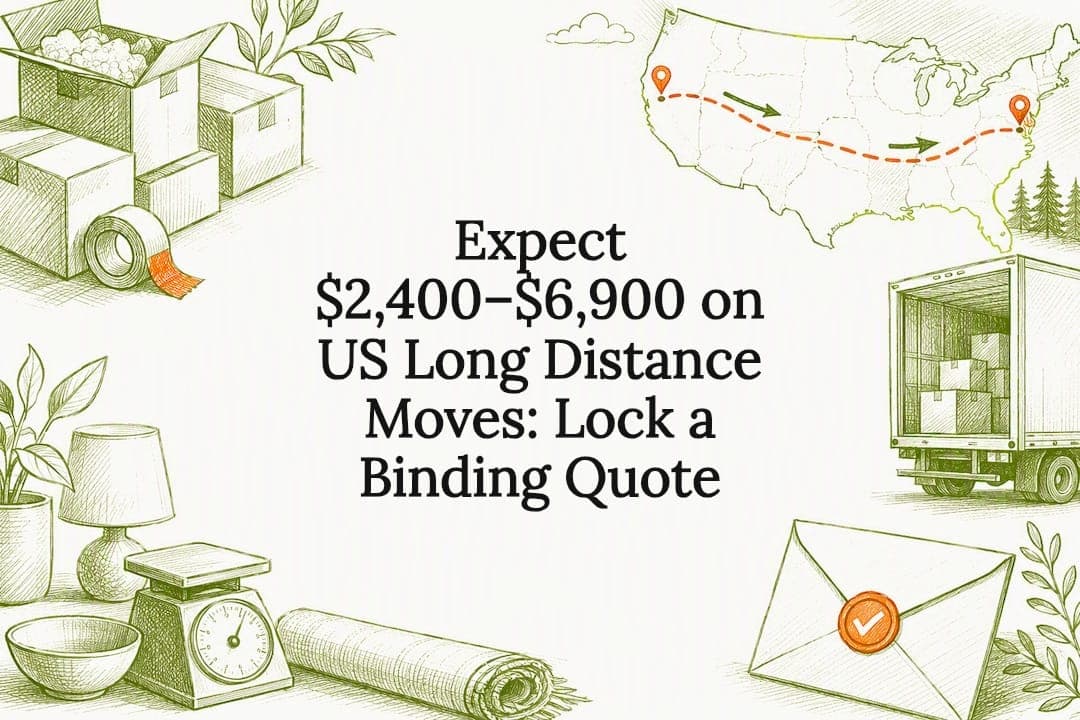
Expect to pay somewhere between $2,400 and $6,900 for a long-distance move, with most U.S. households landing around $4,566 for a cross-country relocation. Distance, shipment weight, and the service level you choose drive that number more than anything else. Your best next move is simple: request a binding in-home or virtual estimate before you sign anything, so the price you're quoted is the price you pay.
TL;DR:
- Most long-distance moves cost between $2,400 and $6,900, with factors like weight, distance, and service level significantly influencing the final price.
- Providing a detailed inventory through an in-home or virtual survey ensures a binding estimate that accurately reflects the true cost, preventing surprises on moving day.
- Full-service movers offer the most convenience, but costs can rise to nearly $9,700 for larger households, while DIY truck rental remains the cheapest option at around $1,200 to $2,100 before fuel.
- Additional charges for long carry, shuttle, stairs, storage, and fuel surcharges can substantially increase costs if not clarified upfront.
- Booking early, moving during off-peak seasons, and reducing shipment weight are effective strategies to lower long-distance moving expenses.
Table of Contents
- How Movers Calculate Long-Distance Moving Cost
- What Does a Cross-Country Move Cost by Service Type?
- What Extra Fees Should You Budget For?
- How Do You Get a Binding Estimate You Can Trust?
- How Can You Lower Your Long-Distance Moving Costs?
- Building Your Long-Distance Moving Budget Step by Step
- Why a Pre-Screened Mover Network Changes the Math
- What I'd Tell a Family Moving Cross-Country This Year
- Get a Binding Quote Without the Guesswork
- Sources
- FAQ
How Movers Calculate Long-Distance Moving Cost
Every interstate quote starts with two numbers: how much your belongings weigh and how far they're traveling. That's the backbone of the math behind a long-distance move, and it's why a studio apartment moving 500 miles costs far less than a four-bedroom house moving 2,000 miles. Weight and mileage set the base rate; everything else is added on top.
Movers arrive at your weight estimate through a survey, either in person or over video. A trained estimator walks through your home, room by room, and builds an inventory that translates into pounds. Skip this step or rush through it, and your final weigh-in at the destination could reveal a heavier shipment than expected, which triggers additional charges.
Beyond weight and distance, a handful of variables swing your final number:
- Valuation coverage. Basic released-value protection is often included at no cost, but it pays out only pennies per pound for damaged items. Full-value protection costs more upfront but covers actual replacement cost.
- Labor requirements. Extra crew for a large home, disassembly of furniture, or a tricky loading dock all add hours to the job.
- Seasonality. Summer moves, especially those clustered around the end of the month, draw premium pricing because demand outpaces truck availability.
- Access issues. Narrow streets, long walks from the truck to your door, or a building that requires a smaller shuttle vehicle all get billed separately.
A binding estimate locks in your price once the inventory is finalized, so none of these variables can surprise you on move day. For a deeper look at how interstate pricing is structured, our interstate moving cost guide breaks down each component separately.
What Does a Cross-Country Move Cost by Service Type?
Cost to move across the country varies enormously depending on how much labor you're willing to take on yourself. A family hiring a full crew to pack, load, drive, and unpack will pay several times more than someone who rents a truck and does it all solo, but the trade-off is time, physical effort, and risk.
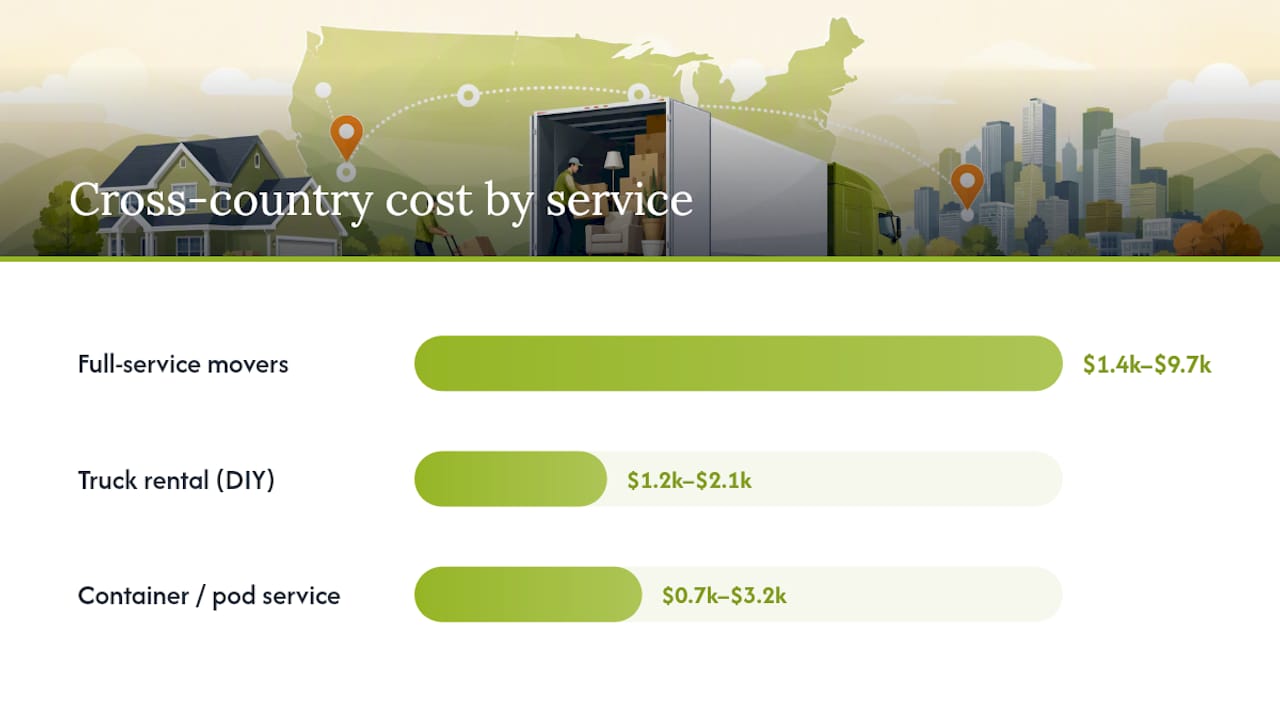
Full-service movers handle everything from wrapping furniture to unloading boxes at your new address. Depending on your home size and distance, full-service long-distance moving costs typically run from around $1,400 for a small one-bedroom move to as much as $9,700 for a large household moving a long haul, according to HomeAdvisor's cost data. You hit the high end when you're moving a four-bedroom house more than 1,500 miles during peak season with full packing service included.
Truck rental (DIY) keeps labor costs off your bill but shifts fuel, tolls, lodging, and your own time onto the ledger. Typical rental costs fall between $1,200 and $2,100 for a cross-country trip, not counting gas, which climbs fast on longer routes. Diesel and gasoline prices fluctuate throughout the year, and EIA fuel data is worth checking before you commit to a DIY budget, since a multi-day drive in a loaded 26-foot truck burns considerably more fuel than your personal vehicle.
Container and pod services split the difference. A company drops a container at your home, you load it yourself, and they handle transport. These run roughly $700 to $3,200 depending on how many containers you need and how far they travel. They work best for people with flexible timelines who don't need same-week delivery.
Freight trailer or shared-load options price by linear footage rather than total weight, which can undercut traditional pricing for households willing to partition space in a shared trailer and load their own share of it. It's a trade of convenience for savings that suits smaller households more than large ones.
Real move data from route-based indexes confirms just how much these ranges shift by home size and corridor. A one-bedroom apartment moving 800 miles and a four-bedroom house moving 2,500 miles are two entirely different budgeting exercises, even within the "full-service" category, so treat every published range as a starting point, not a quote.
What Extra Fees Should You Budget For?
The base quote rarely tells the whole story. Add-on fees are where budgets go sideways, and most of them are avoidable surprises only if you ask about them upfront.
- Long carry fees. If the truck can't park within a set distance of your door, movers charge extra for carrying items farther than usual.
- Shuttle fees. Narrow streets, gated communities, or high-rise buildings sometimes require a smaller shuttle truck to bridge the gap between the moving van and your home, typically adding a few hundred dollars.
- Stair fees. Multiple flights of stairs without elevator access can add a per-flight charge.
- Packing services. Full-service packing runs anywhere from a few hundred dollars for a light load to close to $2,000 for a large home with fragile or specialty items, per HomeAdvisor's breakdown.
- Storage-in-transit. If your new home isn't ready, storing your shipment for a few weeks adds a daily or monthly rate.
- Fuel surcharges. Carriers sometimes tack on a surcharge tied to current diesel prices, particularly relevant when national fuel costs spike.
Valuation coverage deserves its own line item. Released value protection, often included free, pays roughly $0.60 per pound per item if something is damaged. Full-value protection, which reimburses actual replacement or repair cost, adds a premium typically calculated as a percentage of your shipment's declared value.
Don't forget the costs that happen outside the moving contract entirely: hotels along a multi-day drive, meals on the road, and vehicle re-registration in your new state can add several hundred dollars to your true out-of-pocket total, even though they never appear on a mover's invoice.
How Do You Get a Binding Estimate You Can Trust?
Binding versus non-binding is the single most important distinction in long-distance moving, and it's worth understanding before you request your first quote. A binding estimate, as FMCSA explains, locks in your price based on a completed inventory. A non-binding estimate is just a guess. It can go up on moving day if the actual weight exceeds the estimate, and that's exactly how families end up paying hundreds or thousands more than they expected.
Here's how to secure a number you can actually rely on:
- Schedule an in-home or video survey. Walk the estimator through every room, including closets, garage, and storage areas. Leaving items out of the inventory is the fastest way to invalidate your binding price.
- Request the estimate in writing. A proper estimate should list the total weight, the per-pound or flat rate, valuation coverage terms, and every accessorial fee that could apply.
- Confirm it matches your bill of lading. The bill of lading is the actual contract; it should mirror the binding estimate exactly, with no unexplained gaps.
- Get pickup and delivery windows in writing. A verbal promise of dates means nothing once your belongings are on the truck.
- Verify the company's USDOT number. Every legitimate interstate mover must be registered, and you can look up their safety and complaint history before you sign.
Watch for red flags: a mover who won't do an in-home survey, one who demands a large cash deposit before loading, or one who gives you a quote dramatically lower than every competitor. Our guide to choosing a long-distance moving company walks through the vetting process in more detail if you want a fuller checklist.
Pro Tip: Ask for the estimate to state "not to exceed" language if the company won't offer a fully binding number. It caps your maximum liability even under a non-binding structure.
How Can You Lower Your Long-Distance Moving Costs?
Timing is the single biggest lever most people never pull. Moving mid-week, mid-month, or during January and February instead of the peak summer season can save roughly 20 to 30 percent compared with peak pricing, according to NerdWallet's analysis. June through August draws the heaviest demand, so if your schedule allows even a few weeks of flexibility, use it.
Weight reduction is the second-biggest lever, and it's the one most within your control. Since movers price primarily by weight, every box you don't ship is money saved. Sell furniture you won't need, donate clothes you haven't worn in a year, and resist the urge to pack "just in case" items you haven't touched since your last move.
A few other tactics worth considering:
- Go hybrid. Rent a container or truck yourself, then hire independent loaders through the moving company for the heavy lifting only. You skip full-service pricing but avoid throwing out your back.
- Book 6 to 8 weeks ahead. Early booking, especially outside peak season, gives you access to better rates and your preferred delivery window.
- Ask your employer. Relocation assistance policies are more common than people realize, and HR can sometimes cover a meaningful chunk of your bill if you ask early and keep every receipt.
Pro Tip: If your move date has any flexibility, ask movers directly which weekday in your target month has the lowest demand. Some will tell you, and shifting by even three or four days can lower your quote.
Building Your Long-Distance Moving Budget Step by Step
A moving budget isn't one number. It's a stack of smaller numbers you add together, and skipping any layer is how people end up short on cash the week they arrive.
- Start with your baseline service quote. This is the binding estimate for your chosen service type, whether that's full-service, a container, or a rental truck.
- Add measured extras. Factor in packing services, stair or long-carry fees, and any shuttle charges your survey identified.
- Add travel and incidentals. Include hotel nights, meals on the road, fuel if you're driving separately, and vehicle registration fees in your new state.
- Add a contingency line. Set aside 10 to 15 percent of your total estimated cost for anything unaccounted for, from a last-minute storage need to a heavier shipment than expected.
- Compare at least three quotes side by side. Line up the base rate, valuation coverage, and listed fees from each mover before deciding.
Our moving budget worksheet walks through each of these categories with space to plug in your own numbers, and pairing it with a move timeline helps you see which costs hit early (deposits, packing supplies) versus which hit later (final balance, tips, unpacking help).
Why a Pre-Screened Mover Network Changes the Math
Every dollar figure in this guide assumes you're dealing with a licensed, reputable carrier. That assumption falls apart fast when you're comparing quotes from companies you've never vetted, which is exactly the gap Value Added Moving is built to close.
This service connects customers with pre-screened, licensed, and insured moving companies, negotiates competitive quotes on their behalf, aims for transparent pricing without hidden fees, and provides a dedicated coordinator for consistent support. Having a single point of contact is especially helpful for managing binding estimates and tracking moving details.
Customer satisfaction is high across many reviews, reflecting a strong focus on reducing pricing surprises in this industry.
What I'd Tell a Family Moving Cross-Country This Year
If you take one thing from this guide, make it this: book your survey and lock a binding estimate 6 to 8 weeks before your target move date. That window gives you enough runway to compare quotes properly and still land a good crew during busy months.
Build your contingency line before you need it, not after a surprise fee shows up on move day. Ten to 15 percent on top of your estimate has saved plenty of families from a stressful final invoice.
Beyond that, the process isn't complicated. Get your estimate, verify it in writing, and reach out through the quote process when you're ready to compare real numbers instead of guesses.
— Victor
Get a Binding Quote Without the Guesswork
Value Added Moving is the alternative to sorting through unverified listings on your own. Instead of collecting quotes from movers you can't vet, you get matched with a pre-screened, licensed, and insured carrier, with a dedicated coordinator negotiating your price and keeping the estimate binding from survey to delivery.
That single point of contact is the difference between chasing five separate companies for updates and having one person accountable for your move from quote to unpacking. Whether you're relocating a household across three states or coordinating an office move for a growing business, the Full-Service Movers & Packers model walks you through exactly what happens after you request pricing, and what your coordinator handles on your behalf.
Ready to see real numbers instead of estimates pulled from a rough average? Start your free long-distance moving quote today and get a binding price built around your actual inventory, not a guess.
Sources
The figures throughout this guide come from a mix of federal guidance and industry cost data, and you can check every one of them directly.
- How Much Does it Cost to Move Across the Country? 2025 Data — HomeAdvisor
- How to move across the country (timing and savings) — NerdWallet
FAQ
How much does it cost to move 200 miles away?
Moves with shorter mileage typically cost less than the $2,400 to $6,900 range HomeAdvisor reports for full cross-country moves, since shorter routes mean less fuel and drive time factored into the quote. Request a binding estimate to get an exact figure, since home size and weight still drive most of the cost even on a shorter route.
How much does it realistically cost to move out of the USA?
International moves involve customs, shipping logistics, and destination-country fees that go well beyond domestic interstate pricing, so costs vary far more widely and typically run higher than even the high end of the $2,389 to $6,867 domestic range. Get quotes directly from movers experienced in international relocation, since this guide's figures apply specifically to moves within the United States.
What is the most inexpensive way to move long distance?
A truck rental, running roughly $1,200 to $2,100 before fuel, is usually the cheapest option if you're willing to load, drive, and unload yourself. Reducing your shipment's total weight by selling or donating items before you move lowers costs further, regardless of which service type you choose.
What's the cheapest long-distance moving company?
There's no single cheapest mover nationally, since pricing depends on your specific route, home size, and season, which is why comparing binding estimates from multiple pre-screened carriers matters more than chasing a single "cheapest" label. Value Added Moving negotiates competitive quotes across its network specifically to help you avoid overpaying without sacrificing reliability.