Moving from Texas to California means trading a lower cost of living and no state income tax for stronger wages in select industries, better weather, and access to job markets that Texas simply doesn't have in the same concentration. The math only works if you confirm your target region's housing costs before you commit and lock in binding quotes from at least three movers. Do that first, and the rest of this move becomes a logistics problem instead of a financial gamble.
TL;DR:
- Households earning above the regional median in specialized fields tend to benefit from California's higher wages despite increased living costs.
- The typical move distance of around 1,406 miles results in upfront costs between $3,348 and $6,403 for a 2 to 3 bedroom home, depending on services and add-ons.
- Verifying a moving company's licensing, requesting binding estimates, and securing written delivery windows can prevent significant overcharges and logistical issues.
- Establishing California residency within the first 10 days requires prompt actions like DMV registration and updating legal documents to avoid fines.
- Proper planning for timing, budgeting for deposits, and coordinating move-in and move-out dates can reduce costly surprises during the transition.
Table of Contents
- What Are the Pros and Cons of Moving From Texas to California?
- How Much Does It Cost to Move From Texas to California?
- What's the Timeline for a Texas to California Move?
- How Do You Choose and Verify an Interstate Mover?
- Which California Region Fits Your Budget and Career?
- What Should You Do First After Arriving in California?
- What Storage Options Make Sense During a Transition?
- Should You Ship Your Car or Drive It Yourself?
- How Do You Transfer Medical Care and School Enrollment?
- How Do You Update Your Legal Residency After Moving?
- What Do Most Guides Get Wrong About This Move?
- Get Free, Binding Quotes Before You Book Your Move
- Sources
- FAQ
What Are the Pros and Cons of Moving From Texas to California?
The honest answer depends heavily on your industry and income bracket. California pays a premium in tech, entertainment, and biotech that often outpaces what the same role earns in Dallas, Austin, or Houston, but that premium gets eaten quickly by housing costs the moment you cross the state line. Recent reporting shows a sizable and ongoing flow of residents relocating from Texas into California, which tells you something important: plenty of people are making this move work, but they're not making it blind.
What tends to go right:
- Job markets in software, film and media production, and life sciences offer salary bands with few Texas equivalents.
- Coastal and mountain access delivers a climate and outdoor lifestyle that's hard to replicate in most of Texas.
- Cultural infrastructure, from university systems to arts institutions, is dense and well-funded in major metro areas.
- Diversity of industry means more room to pivot careers without relocating again.
What tends to go wrong:
- Housing costs in desirable metros routinely run two to four times what a comparable home costs in most Texas cities.
- California's state income tax, which Texas doesn't levy at all, can claw back a meaningful share of any salary bump.
- Commute times and traffic density in the Bay Area and Los Angeles basin are a real quality-of-life cost, not just an inconvenience.
- Daily expenses, from groceries to childcare, run consistently higher across nearly every California metro.
Households earning above the regional median in a specialized field tend to come out ahead. Retirees on fixed incomes, single-income families, and workers in fields with less regional pay variation often find the math doesn't favor them, at least not without a serious lifestyle adjustment. The people who struggle most are usually the ones who assumed a raise would cover the gap without checking actual rent listings first.
How Much Does It Cost to Move From Texas to California?
The route between Texas and California runs a typical distance near 1,406 miles, according to MoveBuddha's route data, and that distance is the baseline cost driver before anything else gets added. Full-service movers, portable containers, and rental trucks all price this lane very differently, and the gap between them is bigger than most people expect.
Statistic Callout: Route analysis from FreightWaves Checkpoint puts a full-service move for a 2 to 3 bedroom home on this lane at roughly $3,348 to $6,403. Studio and one-bedroom moves land lower, and four-plus bedroom households should expect to land above that range, sometimes well above it depending on distance within each state.
Here's how the three main options typically break down:
- Full-service movers (studio/1BR): Often the smallest full-service jobs on this route, though pricing still depends heavily on pickup and delivery city pairs.
- Full-service movers (2 to 3BR): The FreightWaves range of roughly $3,348 to $6,403 covers most mid-size household moves on this lane.
- Full-service movers (4+BR): Expect the top end of quoted ranges and beyond, since large households add both weight and loading time.
- Moving containers (PODS-style): Generally cheaper than full-service for the same load, but you handle loading and unloading yourself, which adds physical labor and time.
- Rental truck (self-move): The lowest-cost option upfront, but gas, tolls, lodging over multiple driving days, and the physical toll of doing it yourself all offset the savings.
Add-ons change these numbers fast, and they're where most people get surprised by a final invoice that doesn't match the quote they remembered. MoveBuddha's add-on data and FreightWaves both flag the same recurring cost categories:
- Professional packing services: Adds a meaningful chunk to the base price but saves real time and reduces damage claims.
- Stair or long-carry fees: Charged when movers can't park a truck close to your door, common in dense California neighborhoods.
- Storage-in-transit: Necessary if your California move-in date lands after your Texas move-out date, which happens more often than people plan for.
- Specialty-item handling: Pianos, safes, and oversized furniture usually carry a flat surcharge per item.
- Auto transport: Shipping a second vehicle separately from a household move typically runs as its own line item, priced by distance and vehicle type.
Booking timing also moves the price. MoveBuddha's data shows that peak-season pickups, weekends, and end-of-month dates cost more and fill up faster, while mid-week and mid-month bookings in the off-season give you more negotiating room. Delivery windows matter just as much as pickup dates: long carriers consolidate loads across multiple customers to fill a truck efficiently, which is exactly why a written delivery window, not just a pickup date, belongs in your contract from the start.
What's the Timeline for a Texas to California Move?
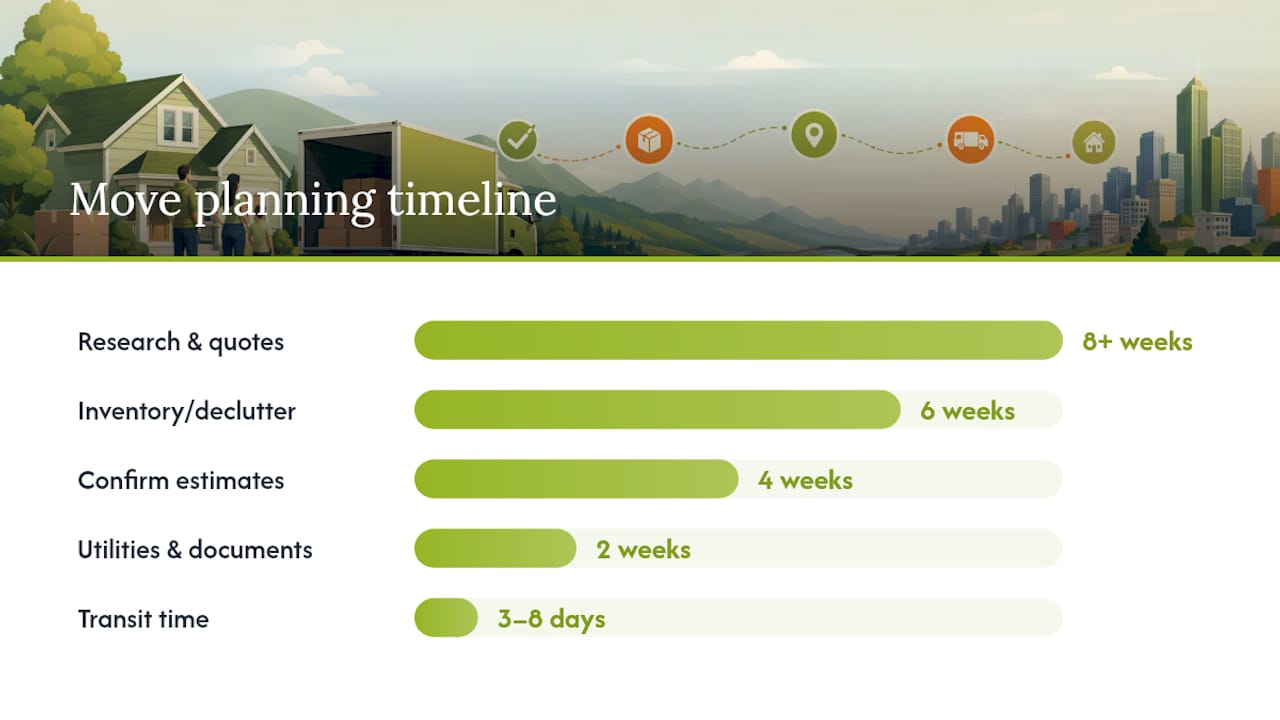
A cross-country move on this lane runs on a predictable schedule if you start early enough, and falls apart fast if you don't. Transit time itself typically runs three to eight days depending on carrier consolidation and scheduling, according to FreightWaves transit-time guidance, but the planning window around that transit matters more than the transit itself.
- 8+ weeks out: Research and request quotes from at least three interstate movers. Peak season (late May through early September) requires booking on the earlier end of this window; off-peak moves have more flexibility.
- 6 weeks out: Walk through your home and build an itemized inventory, then start deciding what actually makes the trip. Long-distance freight charges by weight, so decluttering here saves real money.
- 4 weeks out: Confirm binding or not-to-exceed estimates in writing from your chosen mover, along with a written pickup and delivery window.
- 2 weeks out: Schedule utility disconnection in Texas and connection in California, forward your mail, and start gathering documents you'll need for California DMV visits.
- 1 week out: Pack a "first night" box with essentials, confirm mover arrival times, and if you're driving yourself, plan your route with rest stops factored in for summer heat across West Texas and the desert Southwest.
- Move week: Supervise loading, get a copy of the bill of lading before the truck leaves, and keep valuables and documents with you rather than on the truck.
- First week in California: Set up utilities, enroll kids in school, and start the DMV clock, which begins ticking the moment you establish residency.
Pro Tip: If you're driving across the desert Southwest in summer, plan driving hours around early morning and evening, not midday. Car trouble in 105-degree heat outside El Paso or Yuma turns a minor delay into a serious problem.
A detailed cross-country timeline resource can help you map every one of these steps against your actual moving date, and a pre-move inventory checklist makes the decluttering step far less overwhelming than doing it from memory.
How Do You Choose and Verify an Interstate Mover?
Get a binding or not-to-exceed estimate, not a rough phone quote. Industry guidance across moving-cost analyses consistently recommends this for interstate moves specifically, because written delivery windows and clear valuation coverage materially reduce dispute risk on long lanes where a truck might be carrying multiple households' belongings at once. A phone estimate that isn't tied to an in-home or detailed virtual survey is often the first sign a mover is guessing, not calculating.
Before you sign anything, run this verification checklist:
- FMCSA/SAFER lookup: Confirm the mover's USDOT and MC numbers through the federal Motor Carrier Safety Administration database and check their safety and complaint history.
- California BHGS licensing: For any portion of the move handled within California, confirm the carrier holds active licensing through the state's Bureau of Household Goods and Services.
- Itemized estimate: Ask for a line-by-line breakdown covering weight or cubic footage, packing, fuel surcharges, and any accessorial fees like stairs or long carries.
- Written delivery window: Get the pickup and delivery dates in writing, not verbal assurances, since long-haul carriers consolidate loads across multiple customers.
- Valuation coverage: Understand what's covered if something breaks. Basic released-value coverage is often far less protection than full-value coverage costs.
Verifying FMCSA and BHGS licensing before you sign anything catches a huge share of problem movers before they touch your belongings. Full-service movers make the most sense for larger households, tight timelines, or anyone who can't take a week off work to load and drive a truck. Portable containers work well for people with more flexible schedules who want to save money and don't mind doing their own loading. A rental truck only makes sense for small households with someone available and physically able to do the driving and heavy lifting themselves, and even then, the multi-day drive through Texas, New Mexico, and Arizona heat is a real consideration, not a footnote.
Comparing multiple moving company quotes side by side, rather than accepting the first bid that arrives, is one of the simplest ways to catch a lowball estimate that won't hold once the truck is loaded.
Which California Region Fits Your Budget and Career?
California isn't one housing market, it's five or six very different ones stacked next to each other, and region choice shapes your cost of living far more than the state-level averages you'll see in headlines. Picking the wrong region for your income and industry is one of the most expensive mistakes a Texas transplant can make.
- Bay Area: Dominated by tech salaries that can outpace Texas equivalents substantially, but housing costs are the steepest in the state and commute times punish anyone who buys further from job centers to save money.
- Los Angeles: Entertainment, aerospace, and a genuinely diverse economy support a wide range of incomes, but the metro's size means commute and housing costs vary enormously block by block.
- San Diego: Biotech, defense, and tourism anchor the economy, with a coastal climate that draws a premium, though it's generally more attainable than the Bay Area for comparable housing.
- Sacramento: State government and healthcare jobs anchor a market that's noticeably more affordable than coastal metros, with a growing share of Bay Area transplants chasing lower housing costs.
- Central Valley: Agriculture, logistics, and manufacturing support the most affordable housing in the state, paired with longer commutes into coastal job centers and a hotter, drier climate.
Match your industry to the region before you match your budget to a neighborhood. A tech salary can carry Bay Area rent; a state government salary usually can't. Renters get real protections in California, including statewide rent control provisions that don't exist in Texas, while buyers benefit long-term from Proposition 13, which caps how fast property tax assessments can rise after purchase. That's a meaningful advantage for anyone planning to stay put for a decade or more, though it does little for the sticker shock of the initial purchase price.
What Should You Do First After Arriving in California?
California gives new residents a short runway to get legal, and missing the deadlines carries real fines. The California DMV requires new residents to apply for a California driver's license within 10 days of establishing residency, and to register any out-of-state vehicles within 20 days. Vehicles brought in from Texas may also need a smog inspection as part of registration, depending on the vehicle's age and emissions history.
Statistic Callout: That 10-day and 20-day window starts the moment you establish residency, not the moment you feel settled. Plenty of new arrivals miss it simply because they didn't realize the clock was already running during their first week of unpacking.
Handle these in roughly this order:
- DMV visit: Book your driver's license and vehicle registration appointment online before you arrive if possible; walk-in wait times at busy urban offices can stretch for hours.
- State income tax: California levies a state income tax that Texas doesn't, with rates that climb with income, so adjust your withholding and household budget accordingly.
- Address updates: Notify your bank, employer, the Social Security Administration, and the IRS of your new address to avoid delayed mail on anything time-sensitive.
- Utilities: Set up electric, gas, water, and internet ahead of move-in day; some California providers require a few business days for activation.
- School enrollment: Contact your new district as soon as you have an address, since some California schools require proof of residency documents before enrollment finalizes.
- Medical records: Request a full copy of medical records from your Texas providers before you leave, since transferring them after the fact can take weeks.
What Storage Options Make Sense During a Transition?
A gap between your Texas move-out date and California move-in date is common enough that most movers build storage options directly into their service menu. Storage-in-transit, offered by full-service movers, keeps your belongings in the moving company's custody for a set period, typically billed by the month, until your new home is ready. It's convenient because there's no second load-in and load-out, but it usually costs more per month than renting your own unit.
Self-storage facilities near your new California city are the cheaper alternative if you have a few weeks of flexibility and don't mind coordinating a separate pickup. Climate-controlled units cost more than standard units but matter more in California than in Texas for anything sensitive to humidity swings near the coast. Portable container companies offer a middle path: the container sits at a secure facility until you're ready, then gets delivered directly to your new address.
Decide on storage before moving day, not during it. Movers who know in advance that part of your load is headed to storage can pack and label accordingly, which saves confusion and extra handling fees later. If you're only bridging a week or two, ask your mover whether short-term storage-in-transit is included in your estimate or billed separately. That single question prevents one of the more common surprise charges on interstate moving invoices.
Should You Ship Your Car or Drive It Yourself?
If you're bringing more than one vehicle, you'll need to decide whether to ship one and drive the other, drive both in a caravan, or ship both and fly. Auto transport companies typically quote by distance and vehicle type, and shipping a car on this lane is usually cheaper than most people assume once you factor in the gas, food, lodging, and time cost of driving it yourself over multiple days.
If you choose to drive, route planning matters more on this lane than most people expect. The most common paths run through West Texas, New Mexico, and Arizona, all of which mean long stretches of highway with real heat exposure for much of the year. Check your vehicle's cooling system and tire condition before you leave; a breakdown in a remote desert stretch is a far bigger problem than the same breakdown on a Texas interstate near a city.
No special interstate driving permit is required for a personal vehicle move, but if you're towing a trailer or driving a larger rental truck, check the specific state weight and length rules for any oversized loads, since some rental trucks with trailers cross into commercial vehicle thresholds. Plan fuel stops in advance through the more remote stretches of New Mexico and Arizona, where gas stations can be sparser than Texas drivers are used to. Building in rest breaks every few hours, rather than pushing straight through, reduces both fatigue-related risk and the odds of arriving too exhausted to safely unload.
How Do You Transfer Medical Care and School Enrollment?
Families carry two of the highest-stakes transitions in any move: medical continuity and school enrollment, and both go smoother with a head start. Request full copies of medical records, including immunization histories, prescription lists, and specialist notes, from every Texas provider before you leave. Many practices take one to two weeks to process records requests, so submitting the request the moment your move date is confirmed avoids a gap in care right when you need continuity most.
Start researching in-network providers near your new California address before you arrive, especially for any ongoing specialist care, since not every insurance plan carries the same network across state lines. If you're on an employer plan, confirm with HR whether your coverage transfers seamlessly or requires a new enrollment period tied to your move.
School enrollment works best when you contact the new district as early as possible, since some California schools require proof of residency, such as a signed lease or utility bill, before finalizing enrollment. Request transcripts and any special education or 504 plan documentation from the Texas school directly, and ask whether the new district needs those records translated into their own evaluation format. Families relocating with kids benefit from treating school and medical transfers as their own mini-projects with a checklist, not an afterthought squeezed in during move week.
How Do You Update Your Legal Residency After Moving?
Establishing California residency triggers a cascade of legal updates beyond the DMV deadlines, and voter registration is one most people forget until an election reminds them. You can register to vote in California online through the Secretary of State's website, and registration typically needs to happen well ahead of any upcoming election to count, so don't leave it for the week of a ballot deadline.
Beyond voting, update your legal address with your employer, your bank, any insurance policies, and your will or estate documents if you have them. If you're a business owner or hold a professional license, check whether your license transfers or requires a separate California application. Some professions require state-specific licensing exams or reciprocity agreements that take weeks to process.
Update your vehicle insurance to a California policy as soon as you register your car, since driving on an out-of-state policy past your registration deadline can create a coverage gap you don't want to discover after an accident. Taken together, these updates are less about paperwork for its own sake and more about making sure every institution that matters, from your bank to your polling place, actually knows where you live.
What Do Most Guides Get Wrong About This Move?
The biggest mistake I see people make isn't underestimating the cost of the move itself. It's underestimating the cash they'll need sitting in the bank the moment they arrive, before that first California paycheck clears. Security deposits here often run higher than a full month's Texas rent, and utility deposits for new accounts can add up fast if you don't have an established credit history in the state yet.
The second mistake is timing housing and moving-truck delivery independently, as if they're unrelated. They're not. If your delivery window lands before your lease starts, you're paying for storage you didn't budget for.
Get three binding quotes, confirm your DMV deadlines the day you arrive, and don't sign a lease until your delivery window is in writing. Those three actions prevent most of the costly surprises this move creates.
— Victor
Get Free, Binding Quotes Before You Book Your Move
An alternative to calling movers one by one and hoping the estimates line up is to use a service that matches you with pre-screened moving companies. Instead of chasing quotes from individual companies and cross-checking licensing yourself, you get matched with pre-screened, licensed movers who compete for your business, with transparent pricing and no hidden fees layered in after the fact.
That matters most on a lane like Texas to California, where full-service pricing swings by thousands of dollars depending on home size, add-ons, and how far out you book. Such services can negotiate on your behalf and coordinate the move from quote through delivery, which can be especially valuable if you're managing a tight timeline, a large household, or high-value items that need guaranteed delivery windows in writing. Visit the top-rated out-of-state moving companies page to request free, itemized quotes, and compare written delivery windows and valuation coverage side by side before you commit to any single mover.
Sources
- New to California - California DMV
- Moving from Texas to California (Cost, Movers & Timeline) - FreightWaves Checkpoint
- Moving from Texas to California ($1,340-$7,380) - moveBuddha
- California seeing a sizable influx of new residents relocating from Texas - CBS News
FAQ
Is It Worth Moving From Texas to California?
It depends on your industry and income. Workers in tech, entertainment, or biotech often see the higher wages outweigh California's steeper housing costs and state income tax, while households without a regional pay premium tend to feel the cost gap more acutely.
What State Do Most Texans Move To?
Specific interstate migration rankings shift year to year and vary by data source, but California remains one of the most common destinations for Texas residents relocating out of state, driven largely by job opportunities in specialized industries.
Are People Moving Back to California From Texas?
Reporting confirms a sizable, ongoing flow of residents relocating from Texas into California, suggesting that for a meaningful share of movers, California's job market and lifestyle outweigh the cost difference that originally drove some of them to Texas.
How Long Does a Texas to California Move Take?
Transit time on this route typically runs three to eight days depending on carrier consolidation and scheduling, so confirm your delivery window in writing rather than relying on a verbal estimate.
How Much Does It Cost to Move a 2 to 3 Bedroom Home From Texas to California?
Full-service moves for a 2 to 3 bedroom home on this lane typically range from roughly $3,348 to $6,403, though add-ons like packing, storage, and stair fees can push the final cost higher.