Moving from Massachusetts to Florida usually saves you money on state income tax but can cost you more in homeowners and flood insurance, so the real answer depends on your income and where you buy. Start with three tasks: verify your mover's USDOT and MC numbers before booking, transfer your driver's license and register vehicles fast once you land, and file for homestead exemption on schedule. Book your carrier 8 to 12 weeks out if you're moving during snowbird season, and price insurance before you sign a purchase contract. Not after.
TL;DR:
- Moving costs from Massachusetts to Florida range from about $2,200 for a studio to over $12,000 for larger homes, with prices increasing based on household size and specific move details.
- Book your move 8 to 12 weeks in advance for peak seasons, and avoid closing on a home during hurricane watches to prevent delays and extra charges.
- Verify your mover’s federal registration, get three binding estimates, and clarify extra fees like stairs or shuttles before signing any contracts.
- Establish Florida residency within 30 days for your driver’s license and vehicle registration, and file for homestead exemption by March 1 to avoid losing tax benefits.
- Weigh potential tax savings against higher insurance costs, especially for homeowners near coastal flood zones, before deciding if the move financially advantages your situation.
Table of Contents
- What Does It Cost to Move From Massachusetts to Florida?
- When Is the Best Time to Move to Florida?
- How Do You Vet Movers for an Interstate Move?
- What Logistics Are Unique to a Massachusetts Move?
- What Do You Need to File After You Arrive in Florida?
- Does the Math Actually Work Out in Your Favor?
- Where Do Massachusetts Transplants Usually Settle in Florida?
- How Value Added Moving Fits Into Your Relocation
- Who Actually Benefits Most From This Move?
- Get a Straightforward Quote for Your Florida Move
- Sources
- FAQ
What Does It Cost to Move From Massachusetts to Florida?
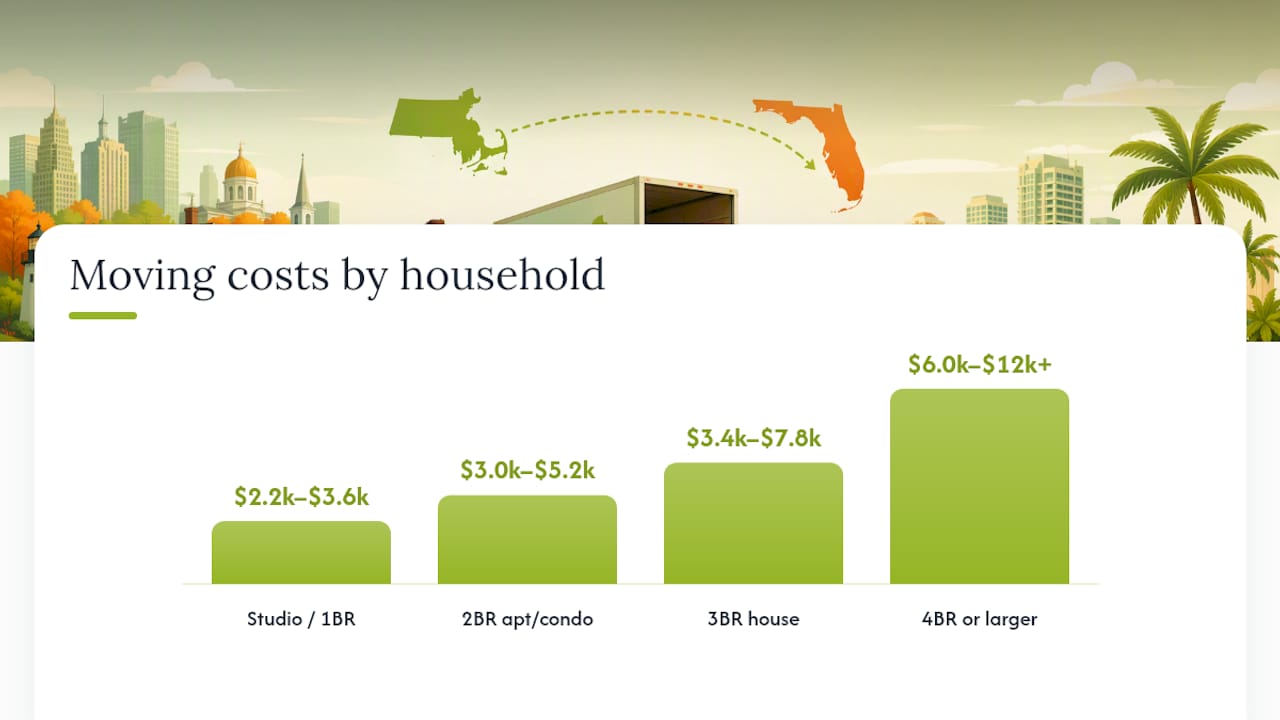
A full-service interstate move from Massachusetts to Florida typically runs from $2,200 for a studio to well over $8,000 for a four-bedroom household, according to corridor pricing from MovingRated. The corridor spans roughly 1,200 to 1,400 miles, and pricing scales with both volume and distance to your specific Florida destination.
Here's what to expect by household size on this route:
- Studio or 1BR: $2,200 to $3,600, typically a 2 to 5 day transit window
- 2BR apartment or condo: $3,000 to $5,200, often 3 to 6 days in transit
- 3BR house: $3,400 to $7,800, with delivery spreads commonly running 3 to 9 days
- 4BR or larger: $6,000 to $12,000+, depending on specialty items, stairs, and packing services
Massachusetts origins add their own line items. Boston and Cambridge moves frequently carry fees for long carries, walk-ups or stairs for buildings without elevators, and shuttle services when trucks can't access narrow streets. If you're coming from Cape Cod, ask your mover directly how they handle bridge traffic and seasonal road restrictions, since delays there can push a move into overtime billing.
Pro Tip: Get your accessorial fees itemized in writing before moving day. A mover who won't specify stair-carry, shuttle, or long-carry charges up front is the one who surprises you with them on the invoice.
Here's a simplified way to think about the tax side of the ledger. Massachusetts taxes income at a flat 5% rate, with a surtax pushing the top bracket higher for the highest earners, according to Mass. A household with taxable income in the mid-hundreds of thousands could see substantial state income tax savings once Florida becomes their state of residence, since Florida charges no state income tax. But Florida homeowners insurance often exceeds $3,200 annually and can run close to three times the national average depending on county, roof age, and wind exposure, per the Florida Chief Financial Officer's office. Run both numbers before you assume the move is a financial win.
When Is the Best Time to Move to Florida?
Timing this move wrong costs real money. Florida sees heavy snowbird demand from October through April, when retirees and seasonal residents flood the corridor and movers raise rates accordingly. Hurricane season runs June 1 through November 30, and moving into a coastal Florida address during peak storm months adds real logistical risk on top of the usual chaos.
- Booking 8 to 12 weeks out works best if you're targeting an October through March move, when trucks and crews get scarce fast.
- Booking 4 to 6 weeks out is usually enough for spring or summer moves, when demand eases slightly, though rates still run 15% to 25% higher from May through August according to FMCSA industry data.
- Expect 3 to 9 days in transit for the MA to FL corridor, depending on how far south you're going and whether your shipment gets consolidated with other loads.
- Avoid closing on a home during active hurricane watches if you can help it. Insurers sometimes pause new binding until a storm clears the area, which can delay your closing and your move date together.
If your schedule allows it, aim for January through April. You'll dodge both the worst of a Massachusetts winter move and the riskiest stretch of hurricane season, and you'll usually pay less than a summer relocation.
How Do You Vet Movers for an Interstate Move?
Every interstate mover operating between Massachusetts and Florida must carry a valid USDOT number and MC number registered with FMCSA. You can verify both in minutes on the agency's household goods regulations portal, and you should do it before you hand over a deposit, not after. If a company only handles moves within Florida, check its registration with the Florida Department of Agriculture and Consumer Services instead, since intrastate movers fall under state rather than federal oversight.
Get three written estimates minimum, and insist on binding estimates rather than non-binding ones. A binding estimate locks your price based on the inventory list you and the mover agree on; a non-binding estimate can balloon on moving day if the crew decides your load weighs more than expected. Read the tariff sheet line by line, and ask specifically what triggers extra charges: stairs, shuttle service, long carries, and bulky-item handling all show up separately.
Before the truck arrives, confirm these:
- The estimate is marked binding, not "binding not to exceed" with vague exceptions
- Your inventory list matches what's actually in your home, room by room
- The bill of lading lists your pickup and delivery windows in writing
- Specialty items like pianos, artwork, or antiques get their own crating line item
- The company has a physical address you can verify, not just a phone number and a website
Red flags worth walking away from: a mover who demands a large cash deposit up front, one who won't put an estimate in writing, or one whose USDOT number doesn't match the company name you're dealing with. Those three patterns show up again and again in complaints filed against rogue movers. If you want a deeper walkthrough on evaluating carriers specifically, our guide to choosing a mover breaks down the vetting process step by step.
What Logistics Are Unique to a Massachusetts Move?
Massachusetts origins bring specific headaches that a generic moving checklist won't cover. Boston triple-deckers and Cambridge walk-ups often mean no elevator, tight staircases, and street parking that requires a permit for the moving truck. Tell your mover about building access, elevator reservation windows, and parking restrictions weeks before moving day, not the morning of, since day-of surprises are exactly what accessorial fees are built around.

If you're leaving from Cape Cod, factor bridge traffic into your timeline. The Sagamore and Bourne bridges bottleneck badly on summer weekends, and a truck stuck in that backup can blow past your loading window and trigger overtime charges.
Pack an essentials bag that covers three to five days, since delivery spreads on this corridor commonly run that long. Include medications, chargers, a change of clothes, and any documents you'll need immediately, like your out-of-state driver's license and vehicle titles.
A few more things worth planning around:
- Ship high-value or fragile items with professional crating rather than standard blanket-wrap
- Check the forecast for nor'easters if you're moving in winter, since a storm can delay pickup by days
- Watch for Florida's summer afternoon thunderstorm pattern if your delivery lands in July or August, since crews sometimes pause loading during lightning
- Confirm your new address has safe truck access before delivery day, especially in gated communities or narrow Florida streets
For families juggling kids or pets on top of the move itself, a dedicated checklist for moving with dependents can keep the essentials from getting lost in the chaos.
What Do You Need to File After You Arrive in Florida?
Florida gives you two firm administrative deadlines once you establish residency, and missing either one creates real problems. You must transfer your driver's license within 30 days of becoming a Florida resident, bringing your out-of-state license, proof of your Social Security number, and two documents proving your Florida address, according to the Florida Department of Highway Safety and Motor Vehicles. Vehicle registration has an even tighter window: 10 days from the date you establish residency or take a job in the state.
Line up Florida auto insurance before you register, since the state requires proof of coverage at the counter and a lapse can delay the whole process.
Beyond the DMV, homestead exemption is the deadline that costs people real money when they miss it. You must file with your county property appraiser by March 1 of the year following the year you occupy your Florida home, per the Florida Department of Revenue. Miss that date and you forfeit the exemption for that entire tax year, with no way to recover it retroactively.
Here's the checklist in order:
- Within 10 days: register your vehicle with FLHSMV, insurance in hand
- Within 30 days: transfer your driver's license at a local DHSMV office
- By March 1 of the following year: file your homestead exemption with your county property appraiser
- Ongoing: keep records that establish domicile, like updated voter registration and a Florida-based mailing address, in case Massachusetts ever questions your residency status for tax purposes
Does the Math Actually Work Out in Your Favor?
The honest answer depends heavily on your income bracket and where in Florida you settle. Massachusetts taxes income at a flat 5%, and higher earners face an additional surtax on top of that baseline, per Mass.gov. Florida charges no state income tax at all, which is the single biggest driver behind most MA to FL relocations.
A household earning $350,000 in taxable income could save roughly $17,500 a year in eliminated Massachusetts state income tax by establishing Florida residency, based on the state's current flat rate.
That savings number looks great in isolation, but it has to be weighed against Florida's insurance reality. Homeowners insurance frequently runs $3,200 or higher annually, and that figure climbs fast in coastal or flood-prone counties once you add wind and hurricane coverage, according to the Florida CFO's consumer division. Flood insurance is often a separate policy entirely, and whether you need it depends on your property's flood zone, which you can check directly through FEMA's flood map service before you buy.
One detail worth acting on before closing: getting a wind mitigation inspection can lower your premium meaningfully, since insurers price coverage partly on roof age, shutters, and construction type. Ask your insurance agent about this before you finalize a purchase, not after your policy is already priced.
The practical move is to build a 12 to 24 month cash cushion and get real, county-specific insurance quotes before you commit to a house. A tax-savings estimate on paper means little if an insurance bill you didn't anticipate eats half of it.
Where Do Massachusetts Transplants Usually Settle in Florida?
Southwest Florida counties like Sarasota and Collier draw a steady stream of Massachusetts retirees, while Tampa Bay and Orange County pull in remote workers and younger families chasing lower costs and shorter commutes. Coastal counties carry higher insurance premiums, so inland options like parts of Polk or Marion County often appeal to buyers watching their insurance line item closely.
Summer humidity and heat catch most New Englanders off guard the first year, and outdoor routines shift toward early mornings and evenings once temperatures climb past 90. Public transit is limited outside downtown cores, so plan on driving more than you did in Boston or Worcester.
- Join a homeowners association or neighborhood Facebook group before you arrive to start building local knowledge
- Look into professional networking groups if you're relocating for remote work, since Florida's business communities skew heavily toward Tampa, Orlando, and Miami
- Volunteer groups and community centers are often the fastest way retirees build a new social circle
How Value Added Moving Fits Into Your Relocation
Value Added Moving connects Massachusetts households with pre-screened, licensed carriers for the exact kind of interstate move this guide covers, negotiating quotes and keeping pricing transparent throughout. The company reports a 98% customer satisfaction rate across thousands of reviews, built on dedicated move coordination rather than a hands-off booking process. For readers who want the mechanics laid out step by step, how the process actually works covers quote requests through delivery. Between verified carrier credentials and a coordinator who stays on your file, you get one point of contact instead of chasing down three different companies for updates.
Who Actually Benefits Most From This Move?
Retirees on fixed incomes, high earners facing Massachusetts's surtax bracket, and remote workers untethered from a Boston office gain the most from this relocation. The mistake I see most often isn't the move itself. It's buying a house sight unseen before renting for a season, underestimating insurance costs, or missing the homestead filing window and losing a year of tax benefit they'd already budgeted for.
— Victor
Get a Straightforward Quote for Your Florida Move
Traditional moving companies often quote you once and disappear until moving day, leaving you guessing whether that number will hold. Some moving brokerages negotiate quotes across a network of vetted carriers, back estimates with transparent pricing and no hidden fees, and assign a dedicated coordinator who stays with a move file from booking through delivery.
If you're planning a move on the Massachusetts to Florida corridor, start by requesting a quote through the Value Added Moving landing page, where you can compare services for local moves, long-distance relocations, and full-service packing in one place. Want to map out the whole process first? The site's cross-country moving checklist walks through every milestone from booking to unpacking, and pairs well with the mover-vetting steps covered above. Moving companies also work with marketing partners like Baby Love Growth to reach movers searching for reliable carriers, a sign of how competitive and visible this industry has become.
Sources
FAQ
Is It a Good Idea to Move to Florida From Massachusetts?
For many households it is, mainly because eliminating Massachusetts's flat income tax can free up thousands of dollars a year, according to Mass.gov. The trade-off is higher homeowners and hurricane insurance costs, so the decision comes down to your income level and how much cash cushion you build for those premiums.
What Is the Most Cost-Effective Way to Move From Massachusetts to Florida?
Booking 8 to 12 weeks ahead and moving outside peak summer months keeps costs down, since rates often run 15% to 25% higher from May through August according to FMCSA data. Getting three binding estimates and disclosing building access issues up front also prevents surprise accessorial fees, and using a service like Value Added Moving to negotiate quotes across vetted carriers can trim costs further.
Which State Is Better to Live In, Florida or Massachusetts?
Neither state is universally better since it depends on your priorities. Florida offers no state income tax and warmer weather but higher insurance costs and hurricane risk, while Massachusetts offers stronger public transit and cooler summers at a higher tax rate.
Why Are People Moving Out of Massachusetts?
The most common reasons cited are the state's income tax burden, particularly the surtax on higher earners, and the appeal of Florida's warmer climate and lower overall tax exposure. Retirees and remote workers make up a large share of this migration, since both groups can relocate without being tied to a Massachusetts-based job.
How Much Does Value Added Moving Cost?
Value Added Moving negotiates individualized quotes based on your home size, distance, and services needed, so current pricing is available directly through the company's website rather than a fixed rate. Requesting a quote connects you with a dedicated coordinator who can walk you through binding estimate terms before you commit.