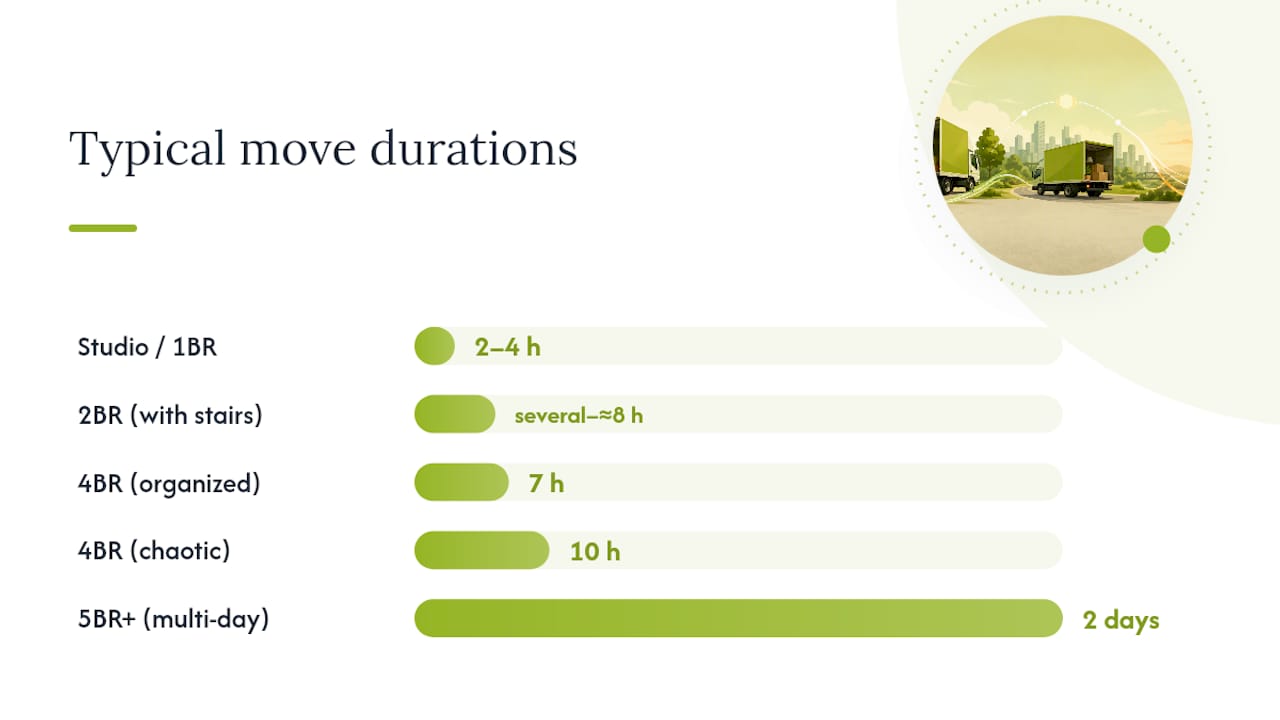
Most moves fall into predictable windows: a studio or one-bedroom runs about two to four hours, a two-bedroom takes three to six, a three-bedroom needs five to eight, a four-bedroom stretches seven to ten, and anything larger often takes ten-plus hours or spans two days. These ranges assume your belongings are already packed and the truck can park close to your door. Stairs, long carries, heavy furniture, or packing on moving day push every number toward the high end, so treat the table and factors below as your next step to narrow it down.
TL;DR:
- Moving time estimates can increase by an hour or more for moves involving stairs, long carries, or heavy furniture, especially when not staged beforehand.
- Larger homes, such as four or five bedrooms, often require most of a day or split into two days, with garage contents and storage areas adding significant time.
- Adding a mover does not always reduce clock hours proportionally, as more crew can work simultaneously, but crew size must match home layout to avoid inefficiencies.
- Local moves under 30 miles usually finish on the same day, but long-distance moves involve separate transit windows and may extend over several days with variable scheduling.
- Proper planning, such as staging, furniture disassembly, and confirming access details 48 hours in advance, can significantly reduce the risk of costly delays.
Table of Contents
- How Long Do Movers Take for Different Home Sizes?
- What Actually Goes Into a Mover's Time Estimate?
- Scenario Breakdown: What Each Home Size Actually Looks Like
- Does a Bigger Crew Actually Save You Time?
- Local Moves vs Long-Distance Timelines
- How to Shave Hours Off Moving Day
- How Value Added Moving Approaches Timing and Coordination
- A Realistic Rule for Scheduling Your Move
- Get a Timeline Built Around Your Actual Home
- Where to Verify Your Rights and Cross-Check Estimates
- Sources
- FAQ
How Long Do Movers Take for Different Home Sizes?
The fastest way to set expectations is to see how crew size and home size interact under normal conditions. Every professional estimate starts here, then gets adjusted for the specifics of your address.
| Home Size | Typical Crew | Total Time Range |
|---|---|---|
| Studio / 1BR | 2 movers | 2 to 4 hours |
| 2BR | 2 to 3 movers | 3 to 6 hours |
| 3BR | 3 to 4 movers | 5 to 8 hours |
| 4BR | 4 movers | 7 to 10 hours |
| 5+BR | 4 to 5 movers | 10+ hours, often split across two days |
These figures assume a local move under roughly 30 miles, ground-floor or elevator access, and boxes already packed and labeled before the crew arrives. Industry calculators commonly put a 2-bedroom move at 3 to 5 hours under those same conditions, which lines up with the low-to-middle part of the range above.
A few notes on which end of the range to expect:
- Lean toward the low end if you have a single-level home, a short driveway-to-truck walk, and zero stairs.
- Lean toward the high end if you're on a second or third floor without an elevator, or if your street requires the truck to park a block away.
- Bedroom count is a proxy, not a promise. A one-bedroom apartment stuffed with a decade of belongings can take longer than a sparsely furnished two-bedroom, which is why a walkthrough or detailed inventory produces a far more reliable estimate than square footage alone.
What Actually Goes Into a Mover's Time Estimate?
Movers don't quote you a single mystery number. They build it from two related but distinct measurements: clock-hours and labor-hours.
Clock-hours is simply how long the job takes from the moment the crew arrives to the moment they leave. Labor-hours multiplies crew size by clock-hours. A 4-hour job with three movers equals 12 labor-hours, and that labor-hour figure is what companies actually price, because it reflects the total work performed, not just the elapsed time on your street.
That distinction explains why adding a mover to a job can shrink your bill's clock-hours while the labor-hours total stays similar or even rises slightly. You're paying for more simultaneous hands, not necessarily less total effort.
A typical moving-day clock breaks into several components:
- Loading: carrying and securing items into the truck
- Transit: driving between the two addresses
- Unloading: carrying items in and placing them by room
- Packing-on-day: any boxing done by the crew instead of you
- Staging and paperwork: inventory sign-off, walkthrough, bill of lading review
Stairs commonly add around an hour per flight, and long carry distances between the truck and the door can add another 30 to 120 minutes, according to moving labor hour models. Heavy or awkward items, think pianos, gun safes, or oversized sectionals, function as time multipliers rather than flat additions, since they often require extra hands, blankets, and careful maneuvering that a standard box never needs.
Scenario Breakdown: What Each Home Size Actually Looks Like
Ranges are useful, but seeing how they play out with real complications attached is what makes them usable. Here's how each home size typically unfolds, and what pushes the clock in the wrong direction.
Studio and one-bedroom moves
A studio or one-bedroom with two movers usually wraps in two to four hours when everything is boxed and staged near the door. The most common slowdown isn't the apartment itself, it's the building. A third-floor walk-up with no elevator can add 45 minutes to over an hour compared to ground-floor access. Elevator buildings introduce a different problem: waiting. If you haven't reserved the freight elevator in advance, your crew may lose 20 to 30 minutes standing around while a neighbor moves in furniture on the same schedule.
Two-bedroom moves
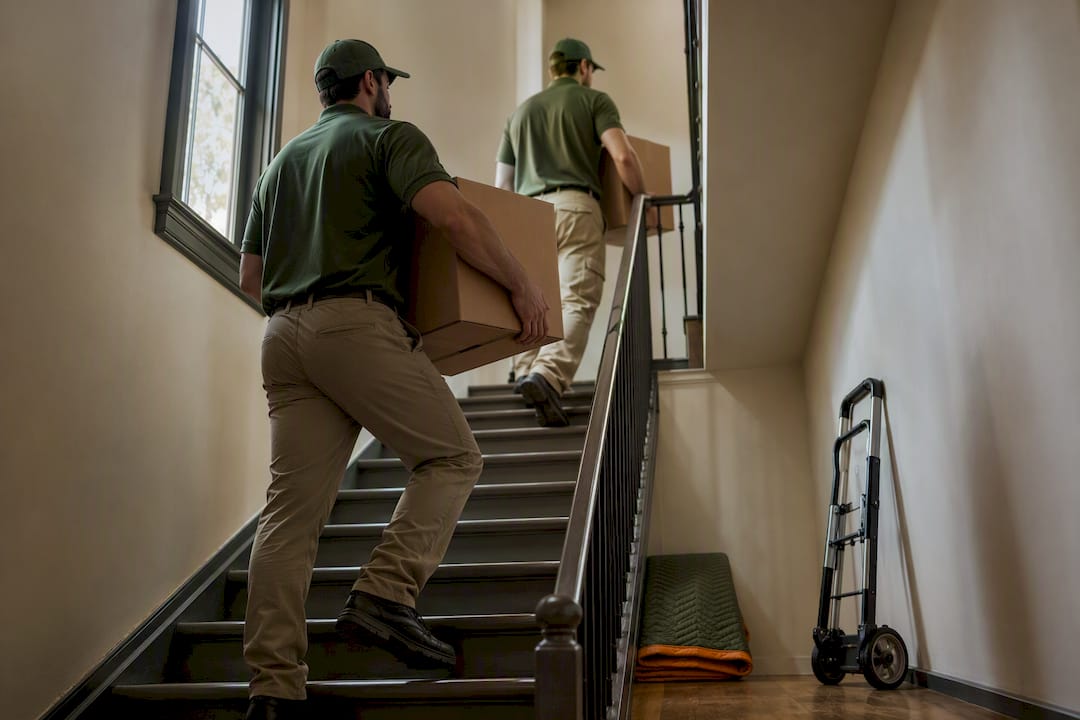
Two-bedroom homes with a 2 to 3 person crew generally take several hours, and this is where packing-on-day starts to matter. If even half your kitchen and closets are unpacked when the crew shows up, expect an extra hour or more tacked on, since your movers become packers first and haulers second. A single flight of stairs at either end adds roughly an hour on its own, so a two-bedroom with stairs at both pickup and drop-off can drift toward the eight-hour mark even though the square footage hasn't changed.
Three-bedroom moves
Three-bedroom homes usually need three to four movers and run for several hours, and this is typically the first home size where garages and basements enter the picture. Storage areas hide volume that bedroom counts never capture, tools, holiday decorations, old furniture, sporting equipment, and it's common for a "three-bedroom move" to actually carry the item count of a much larger home once the garage gets factored in. Heavy furniture like sectional sofas, china cabinets, and treadmills each typically add 15 to 30 minutes of dedicated handling time beyond what a similarly sized box would take.
Four-bedroom-plus moves
Four-bedroom and larger homes with four to five movers often require most of a day, and five-bedroom or larger properties frequently get split across two days by design rather than by delay. At this scale, the difference between a well-organized home and a chaotic one becomes dramatic. Clear pathways and pre-staged rooms can keep a four-bedroom inside the seven-hour mark, while a home where movers have to navigate around furniture, kids, and pets can push past ten hours even with an adequate crew size.
Pro Tip: Walk your own home the night before as if you were the moving crew. Note every point where a mover would have to stop, squeeze past something, or ask "where does this go?" Each of those pauses is exactly the kind of friction that adds unplanned hours.
Does a Bigger Crew Actually Save You Time?
More movers mean fewer clock-hours, but not in a simple one-to-one way, and understanding the math helps you avoid overpaying for a crew size you don't need.
- Two movers handle loading and unloading sequentially in many cases: one carries while the other secures items or navigates doorways. This works fine for studios and one-bedrooms but becomes a bottleneck for anything larger.
- Three movers allow one person to stay in the truck organizing and securing the load while two continue carrying, which keeps the line moving instead of stalling at the truck door.
- Four movers enable true parallel work, one team loading furniture while another handles boxes, and this is typically where the biggest time savings appear for three-bedroom-plus homes.
Adding a third mover to a job can cut total clock time by 25 to 40% in many cases, since teams can work simultaneously instead of taking turns. That said, more hands aren't automatically better for a small apartment. A two-bedroom with narrow hallways can actually slow down with four movers if there's no room for two people to pass each other carrying furniture. Crew size should match your home's layout, not just its square footage, and heavier items like refrigerators or sofa beds benefit from the extra safety margin a larger crew provides regardless of overall time savings.
Local Moves vs Long-Distance Timelines
A local move and a long-distance move aren't the same event stretched over more miles. They're governed by different scheduling logic entirely.
Local moves (typically under 50 miles) usually complete same-day, following the size-based ranges outlined earlier. They still run long when traffic between addresses is heavy, when the drive itself is on the longer end of "local," or when either location has restricted parking that forces a longer carry distance.
Regional and long-distance moves work differently because your belongings often travel on a truck that also serves other customers, known as a consolidated or shared-carrier shipment. Instead of a single delivery time, you get a delivery window, frequently spanning several days to two weeks depending on distance and route. Our cross-country moving timeline guide breaks down exactly what happens between pickup and delivery on interstate moves.
A few realities of long-distance timing worth knowing before you book:
- Loading day itself follows the same hourly logic as a local move, home size and access still drive the clock.
- Transit time is separate from loading and unloading time, and carriers quote it as a window, not a guaranteed date.
- Shared-carrier shipments can shift delivery earlier or later based on other customers' pickups along the route, which is a normal part of how consolidated freight works, not a sign of a problem.
How to Shave Hours Off Moving Day
Most of the time you lose on moving day is preventable. These steps, done in the week before and the day before, consistently shrink the clock.
- Pack and stage everything near exits. Boxes should be sealed, labeled by room, and clustered close to the door your movers will use, not scattered through the house.
- Disassemble furniture in advance wherever you safely can, bed frames, tables, and shelving units take far longer to break down on the spot than to reassemble later.
- Confirm access 48 hours out. Reserve elevators, secure a parking permit if your street requires one, and note any building rules about move-in hours.
- Flag heavy or awkward items ahead of time so your crew arrives with the right equipment, dollies, straps, or extra hands, instead of improvising.
- Designate one decision-maker on site. When three people are answering "where does this go?" differently, boxes get set down, picked back up, and moved twice.
Before booking, ask your mover directly: how many movers are you sending, what's included in that hourly rate, and does the quote assume everything is already packed? Their answers tell you whether the estimate matches your actual home, not just its bedroom count.
Pro Tip: Confirm your crew size and arrival window by phone the day before, not just by email. Last-minute crew changes are one of the most common reasons a scheduled morning move slips into the afternoon.
How Value Added Moving Approaches Timing and Coordination
We connect customers with pre-screened, licensed, and insured movers and negotiate quotes based on your actual inventory rather than rough estimates based on bedroom count. That distinction matters because inventory-based quotes catch the garage full of tools or the extra bookshelf that bedroom-count estimates routinely miss.
Brokered coordination reduces the timing surprises that cause overtime disputes and delayed delivery windows:
- Walkthroughs or detailed inventory lists replace guesswork with a specific item count.
- Crew size gets confirmed against your home's actual access conditions, stairs, elevators, parking distance, before moving day arrives.
- Dedicated coordination means fewer last-minute crew swaps, which are one of the most common causes of schedule slippage.
If you want a timeline built around your actual home rather than a generic average, requesting a walkthrough is the most reliable way to get one.
A Realistic Rule for Scheduling Your Move
The biggest mistake I see in moving-day planning isn't a bad estimate, it's trusting a good one too literally. Packing that spills into moving day, elevator waits nobody scheduled around, and last-minute decisions about what to keep all eat into a number that looked solid on paper.
Finishing early costs you nothing. Running into overtime because nobody planned for the second-floor walk-up costs you plenty. If your home has any complexity at all, get an inventory-based estimate before you set your moving date in stone.
— Victor
Get a Timeline Built Around Your Actual Home
Generic hourly quotes based on bedroom count leave too much room for surprise overtime charges, especially once stairs, storage areas, or a long carry distance enter the picture. We provide an alternative to guessing by connecting you with pre-screened, licensed, and insured movers and negotiating quotes built from your real inventory, so the hours you're quoted reflect your move more accurately.

That inventory-based approach is also what protects your delivery window on long-distance moves, where transit time and shared-carrier scheduling add a layer of complexity a local move never has. If you're planning an interstate relocation, our long-distance moving company guide explains how pickup and delivery windows typically work.
Ready to see what your actual move would take? Request a personalized quote and timeline and get matched with a vetted crew sized correctly for your home.
Where to Verify Your Rights and Cross-Check Estimates
For consumer protections around delivery windows and shipment rights, the FMCSA's Protect Your Move resources outline what carriers owe you in writing. To cross-check a time estimate against your specific bedroom count, crew size, and stairs, a moving time estimator models those variables directly rather than relying on a flat average.
Sources
- Protect your move | Federal Motor Carrier Safety Administration
- Moving Time Estimator — Moving Mentor
- Moving and packing time estimator | calculatask
- Moving labor hours calculator | Moving Muscle Blog
FAQ
How long do movers usually take to move a house?
Most homes take between three and ten hours depending on size and crew, with studios finishing in two to four hours and four-bedroom-plus homes often requiring a full day or two-day split.
Is $100 per mover a good tip?
Tipping norms vary, and many people tip based on hours worked or a percentage of the total bill, adjusted for how demanding the job was.
How fast can you hire movers?
Some companies offer next-day or even same-day booking for local moves, though securing your preferred date and crew size usually requires at least a week or two of lead time, especially during peak moving season.
Is it common for movers to be late?
Short delays happen, particularly with traffic or a longer job at a previous stop, but a reliable company communicates proactively about arrival windows rather than leaving you guessing; confirming your crew and access 48 hours ahead, as recommended earlier, helps minimize this risk.
Recommended
- Weekend Office Move: Prepare Your Business for Monday Operations
- How to Plan a Long Distance Office Relocation Without Business Downtime
- How to Find Reliable Movers for Your Office Relocation | Tips
- Cross-Country Moving Timeline: Every Step From Quote to Unpacking
Made with BabyLoveGrowth to improve Google and AI visibility