A local move typically runs within a few hundred to a few thousand dollars, while a long-distance or interstate move usually costs several thousand dollars or more. Three factors swing that range the most: how much you're moving (home size and weight), how far it's going, and whether you hire full-service help or handle parts of it yourself. Everything else in your quote flows from those three variables.
TL;DR:
- Long-distance moves generally cost several thousand dollars or more, heavily influenced by shipment weight, distance, and service level, with interstate rates at a few cents per pound per mile.
- Costs vary significantly based on home size, with a 3-bedroom home typically requiring a heavier shipment and incurring higher prices, especially for long-distance relocations.
- Regional price differences can reach 40% to 60% above or below the national average due to local fuel prices, labor markets, and urban demand, affecting your overall budget.
- Estimates should be confirmed through in-home or virtual walk-throughs and written, binding quotes to avoid hidden fees and surprises on move day.
- Extras such as fuel surcharges, stairs, long carries, and shuttle fees are common add-ons that must be itemized beforehand to prevent unexpected charges.
Table of Contents
- Average Moving Cost by Home Size: Local vs Long-Distance
- What Actually Drives Your Moving Cost?
- How Do Movers Calculate Your Estimate?
- The Add-On Fees That Inflate Your Final Bill
- DIY, Container, or Full-Service: What's the Real Cost?
- When Should You Book to Get the Best Price?
- How to Get an Estimate You Can Actually Trust
- Insurance, Valuation, and Tax Basics You Should Know
- Simple Ways to Cut Your Moving Cost Without Cutting Corners
- Why Comparing Moving Quotes Yourself Rarely Works Out
- Get a Transparent Moving Quote Without the Guesswork
- Sources
- FAQ
Average Moving Cost by Home Size: Local vs Long-Distance
The fastest way to sanity-check any quote you receive is to compare it against typical costs for similar households. Home size generally serves as a proxy for shipment weight, which heavily influences moving estimates, especially for interstate relocations.
Here's how costs generally break down across common home sizes, based on national cost data from Opendoor and industry averages compiled by MoveSmart:
| Home Size | Approx. Shipment Weight | Local Move Cost | Long-Distance Move Cost |
|---|---|---|---|
| Studio / 1 Bedroom | Moderate weight | Cost for local moves varies by home size | Cost for long-distance moves varies by home size and distance |
| 2 Bedroom | Moderate to larger weight | Cost range depends on specific move details | Cost range depends on specific move details |
| 3 Bedroom | Larger weight range | Prices reflect more volume and labor | Prices reflect more volume and labor |
| 4 Bedroom | Heavy shipment weight | Higher costs typical for local moves | Higher costs typical for long-distance moves |
| 5+ Bedroom | Heaviest shipment weight | Highest local moving costs | Highest long-distance moving costs |
These figures represent typical full-service moves, meaning a crew loads, transports, and unloads your belongings. A studio apartment with minimal furniture might land at the low end of its range, while a 1-bedroom stuffed with heavy furniture and a home gym can push toward the next bracket up.
Notice how the long-distance figures jump so much higher than local ones even at the same home size. That gap isn't padding. It reflects fuel costs, tolls, driver labor across multiple days, and the fact that interstate carriers price primarily by weight and mileage rather than by the hour.
State-level variance adds another wrinkle. Moving costs in states with high fuel prices, dense urban traffic, or strong union labor markets can run 40% to 60% above or below the national average, depending on where you're starting and ending. A move originating in a major metro like Los Angeles or New York will typically cost more than an equivalent move starting in a smaller Midwestern city, purely because of local labor rates and demand.
One more nuance worth flagging: some guides report interstate moves averaging $4,500–$8,200 depending on distance, which sits comfortably within the ranges above once you account for how far the shipment is actually traveling. Moves categorized as "long-distance" vary widely in cost depending on the actual distance and route, so two moves both classed this way can differ substantially in price.
If you want to see how your specific numbers compare across move types, Valueaddedmoving's guide on local vs long-distance moving breaks down the service differences that explain why the price gap is so wide. And if you're the type who wants every line item accounted for before booking anything, a moving budget worksheet can help you track quotes against these benchmarks as you collect them.
What Actually Drives Your Moving Cost?
Two inputs dominate every moving quote: distance and weight. Everything else, from timing to access issues, adjusts the price around those two anchors.
- Distance determines whether you're billed hourly (local) or by weight-and-mileage (long-distance), and it directly sets fuel and labor-day costs for interstate carriers.
- Shipment weight or volume is the primary pricing unit for long-distance moves. Heavier loads cost more to transport regardless of how far they travel.
- Service level ranges from labor-only (you drive the truck, they load it) to full-service (they pack, load, drive, unload, and unpack), with cost rising at each tier.
- Timing matters more than most people expect. Summer weekends and month-end dates carry demand-driven price premiums that can add hundreds of dollars to an otherwise identical move.
- Access difficulty at either address, meaning stairs, long carries from the truck to the door, or lack of elevator access, often triggers separate surcharges movers add after the initial walk-through.
- Regional labor markets push base rates up or down. A crew in a high-cost metro area simply charges more per hour than one in a smaller city, independent of the move itself.
You can control several factors: when you move, how much you're moving, and which service tier you choose. However, regional rate differences depending on the states involved are outside your control, so budgeting accordingly helps prevent surprises.
How Do Movers Calculate Your Estimate?
Local movers almost universally bill by the hour, typically charging a moderate hourly rate per mover, plus a truck fee. A 3-bedroom local move with a four-person crew might run six to eight hours, which is where the $1,800–$3,000 range in the table above comes from.
Interstate movers price differently. They calculate cost using your shipment's total weight and the mileage between origin and destination, often citing rates in the range of a few cents per pound per mile once fuel surcharges are factored in. This is why asking a carrier for their specific per-pound and per-mile rates is one of the best ways to test whether a quote is realistic. If the numbers don't scale sensibly against your estimated weight, something is off.
Here's the red flag worth remembering: if a company quotes you an hourly rate for a long-distance move, treat that as a warning sign. Legitimate interstate carriers price by weight and mileage, not by the clock. An hourly interstate quote often signals an unlicensed or unreliable operator.
This is also why an in-home or virtual inventory walk-through matters so much before you sign anything. A mover who quotes your 3-bedroom house without ever seeing your belongings is guessing, and guesses turn into disputed charges on moving day. Valueaddedmoving's breakdown of flat-rate versus hourly pricing walks through how to compare these billing structures side by side.
The Add-On Fees That Inflate Your Final Bill
Base estimates rarely include everything you'll actually pay. Surcharges get added once movers see your specific situation, and if they're not itemized in writing beforehand, they become the most common source of moving-day disputes.
- Fuel surcharges, typically a percentage of the base rate tied to current fuel prices.
- Stair and long-carry fees, charged when the crew has to carry items up flights of stairs or a long distance from the truck to your door.
- Shuttle fees, applied when a full-size truck can't access your building and a smaller vehicle has to ferry items back and forth.
- Bulky-item charges for pianos, safes, pool tables, or oversized furniture that require extra hands or equipment.
- Elevator reservation or permit fees, common in high-rise buildings or cities that require street parking permits for moving trucks.
Every one of these should appear as a line item on your written estimate and again on the Bill of Lading, the legal contract between you and the mover. Before you sign, ask directly: "Are stairs, long carries, or shuttle service included in this number, or will they be added later?" Getting that answer in writing is the difference between a predictable bill and an unpleasant surprise on move-out day.
DIY, Container, or Full-Service: What's the Real Cost?
The sticker price of a rental truck looks appealing until you add up everything around it. Here's how the four main approaches actually compare once hidden costs are factored in.
- DIY truck rental: Cheapest upfront, often $150 to $400 for a one-way rental, but you absorb fuel, insurance, packing materials, and the physical labor and time cost of loading and driving it yourself.
- Moving containers (pack yourself, they drive): Middle ground on price, generally $2,000 to $5,000 for long-distance, but you still do all the packing and loading labor, and delivery windows can be less predictable than full-service.
- Labor-only services: You rent the truck, they provide the loading and unloading crew, useful if you're comfortable driving but not comfortable lifting furniture.
- Full-service movers: Highest sticker price, but includes packing, loading, transport, unloading, and often unpacking, with the mover carrying liability for damage during transit.
The gap between DIY and full-service often shrinks once you add up truck rental, fuel, insurance, boxes, tape, and the value of the two or three days you'd spend doing the labor yourself. Professional movers also reduce your risk of property damage and personal injury, both of which carry real costs even when they're not on the invoice.
Pro Tip: If you're weighing DIY against full-service, price out a container option first. It often reveals whether your real motivation is saving money or just avoiding the hassle of vetting a moving company, and that answer usually points you toward the right choice.
Liability also differs sharply. A DIY move puts you on the hook for any damage, since there's no carrier valuation coverage. A full-service move includes some baseline liability protection by default, with the option to purchase more.
When Should You Book to Get the Best Price?
Transit time and timing both affect your final cost, and planning around them is one of the easiest ways to avoid paying a premium.
- Expect 1 to 3 days transit for regional moves under 500 miles, and 5 to 10 days for cross-country moves, depending on the carrier's route and current demand.
- Avoid summer weekends and month-end dates when possible. These are peak demand windows, and carriers often charge premium rates simply because they can fill their trucks without discounting.
- Book 6 to 8 weeks ahead for long-distance moves during peak season (May through September), and 3 to 4 weeks ahead during off-peak months.
- Choose mid-week, mid-month dates whenever your schedule allows. Moving off-peak is often a bigger cost lever than negotiating on price with the same company.
If your move date is flexible, that flexibility is worth real money. A crew that has open availability on a Tuesday in October has every incentive to offer a better rate than one that's fully booked on a Saturday in July.
How to Get an Estimate You Can Actually Trust
A verbal quote over the phone should not be your main budgeting figure. Before committing to any mover, confirm key details in writing to avoid surprises.
- Request an in-home or virtual walk-through so the estimator can see your actual belongings, not guess based on your description of "a few boxes and some furniture."
- Insist on a written, binding estimate, not a non-binding "not-to-exceed" figure that can still change on move day.
- Ask about valuation coverage options and get clear on what's excluded. Standard coverage is often thinner than people assume.
- Confirm your pickup and delivery windows in writing, along with cancellation fees, change fees, and what happens if your dates shift.
- For interstate moves, verify the carrier's USDOT number and ask what documents they'll provide, including the Bill of Lading and an order for service.
Getting these five things in writing before you sign turns your moving budget from a guess into a plan. A vague estimate today becomes a disputed charge in three weeks, and by then you have far less leverage to push back.
Insurance, Valuation, and Tax Basics You Should Know
Moving companies commonly offer two main valuation options: a basic coverage with limited liability per item based on weight and a more comprehensive coverage that covers the current market value of damaged or lost items, usually at extra cost.
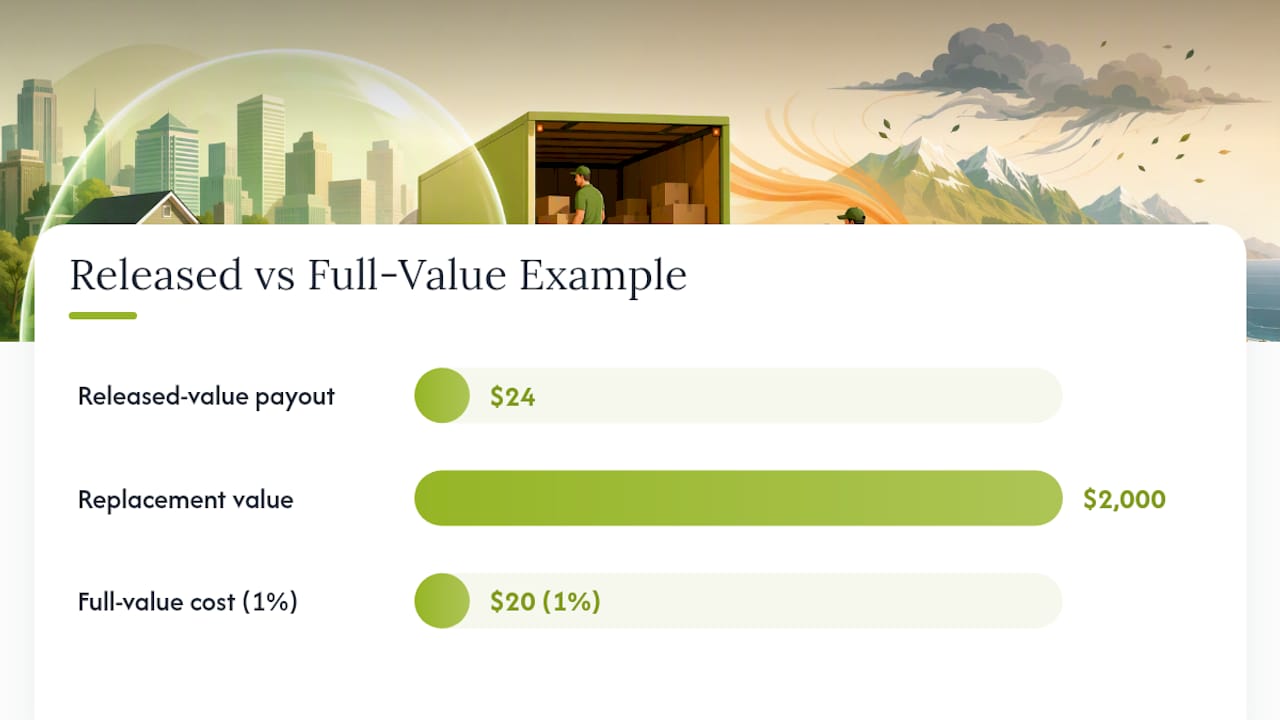
Released-value coverage is usually free but offers weak protection. If a $2,000 television weighing 40 pounds gets damaged, released-value coverage pays out $24. Full-value protection costs more upfront, typically 1% of your shipment's declared value, but it actually covers what your belongings are worth. If you own furniture, electronics, or anything with real replacement cost, full-value protection is generally worth the extra expense.
On the tax side, moving expense deductions are far more limited than they used to be for most taxpayers. The IRS provides official guidance on moving expense deductibility, and current rules depend heavily on your filing status and circumstances. If your move is employer-related, IRS Topic No. 455 explains how reimbursements are treated for tax purposes. Check both pages directly rather than relying on secondhand summaries, since these rules can shift year to year.
Simple Ways to Cut Your Moving Cost Without Cutting Corners
Since weight and timing drive most of your final bill, the biggest savings usually come from adjusting those two things rather than haggling over hourly rates.
- Declutter before the estimate, not after. Since long-distance pricing is weight-based, selling or donating that old dresser you don't love often saves more than negotiating labor charges ever will.
- Book off-peak dates (mid-week, mid-month, outside summer) to access lower base rates and better crew availability.
- Get three to four binding quotes and compare them line by line, not just the bottom-line total.
- Pack non-fragile items yourself to reduce the labor hours a full-service crew bills you for, while still letting professionals handle fragile or bulky items.
- Bundle services like packing and unpacking into one contract when the combined rate beats booking them separately.
Pro Tip: Before you call a single mover, walk through your home room by room and estimate your total shipment weight using the table earlier in this article. Movers can't argue with a number you've already calculated yourself, and it gives you a baseline to challenge inflated estimates.
If you're also relocating to save on housing costs, exploring shared housing options at your destination can meaningfully offset your overall relocation budget, especially for renters moving to a more expensive market.
Why Comparing Moving Quotes Yourself Rarely Works Out
Most people assume getting three quotes means getting three comparable numbers. It doesn't. One company quotes hourly, another quotes weight-and-mileage, a third buries stair fees in fine print you won't read until move day. You end up comparing apples to oranges while under time pressure, which is exactly when people accept the wrong bid.
The real problem isn't finding movers. It's finding ones who are licensed, insured, and pricing you honestly from the start. Valueaddedmoving connects customers with pre-screened, reliable moving companies across the country specifically because that vetting step is where most moving headaches actually begin.
— Victor
Get a Transparent Moving Quote Without the Guesswork
This approach avoids calling multiple moving companies yourself and hoping you picked the honest one. Instead of piecing together quotes with different billing structures and undisclosed fees, a dedicated move coordinator negotiates pricing on your behalf and puts it in writing with no hidden charges.

This approach makes the most sense if you're managing a complex long-distance move, transporting valuable belongings you don't want to gamble on, or simply don't have the bandwidth to vet carriers, compare Bills of Lading, and chase down USDOT numbers on your own. Valueaddedmoving's full-service process handles the vetting, the quote negotiation, and the coordination from your first call to the day boxes land at your new address. If you're planning an interstate relocation, start by requesting a quote through Valueaddedmoving's landing page and get a real number instead of another guess.
Sources
- How Much Does It Cost to Move in 2026? Full Cost Breakdown — Opendoor
- Moving Cost Guide 2026: Local & Long-Distance Averages — MoveSmart
- Moving costs — ConsumerAffairs
- Can I deduct my moving expenses? — IRS
FAQ
How Much Does It Cost to Move a 3,000 Sq Ft House?
A 3,000 square foot home typically falls in the 4 to 5 bedroom range, costing roughly a few hundred to a few thousand dollars for a local move and several thousand dollars or more for a long-distance move, depending on total shipment weight and distance.
How Much Should You Tip on a $500 Move?
A common guideline is 15% to 20% of the total cost, which works out to $75 to $100 split among the crew, though many people simply tip $20 to $40 per mover for a half-day local move.
How Much Does It Realistically Cost to Move Out of the USA?
International moves typically run several thousand dollars higher than domestic long-distance moves, often $3,000 to $10,000+ depending on destination, shipping method, and customs requirements, since neither of the cited sources covers international pricing specifically, you should budget conservatively and get direct quotes from carriers experienced in international relocations.
What Is the Cheapest Day to Hire Movers?
Mid-week days, particularly Tuesday through Thursday, are typically the cheapest, since demand and pricing both drop outside weekends and month-end dates when most people schedule their moves.
Is a Full-Service Move Worth the Extra Cost Compared to DIY?
For many households, yes, since DIY costs like truck rental, insurance, and packing materials add up quickly once you also factor in the time and physical risk of moving heavy items yourself.