Start planning at least several weeks before your move date, and build a moving folder the same week. Give your landlord written notice, measure your doorways and elevator dimensions, and set a realistic budget before you book a mover. Everything past that point, from packing nonessentials to the final walkthrough, follows a predictable timeline. This guide walks through that timeline week by week, plus a room-by-room checklist for move-in day.
TL;DR:
- Starting the moving process six to eight weeks in advance allows for securing elevator reservations, scheduling inspections, and accurate budget planning.
- Document all apartment conditions through photos and receipts before move-out and after move-in to protect your security deposit against unfair deductions.
- Confirm building-specific move-in and move-out rules, including elevator reservations and insurance requirements, well before the scheduled move date.
- Label boxes clearly by room and priority, and pack an essentials box for the first 24 to 48 hours to streamline unpacking and cover immediate needs.
- Using professional moving services that handle logistics and paperwork can save time, reduce stress, and ensure compliance with building regulations.
Table of Contents
- Your Week-by-Week Apartment Moving Checklist
- What Do You Need to Do Before Moving Out of an Apartment?
- Room-by-Room Move-In Checklist for Your New Apartment
- Packing Supplies, Labeling, and the Essentials Box That Saves Your First Night
- How Do You Handle Elevator Reservations, Parking, and Building Rules?
- What Should a Moving-Day Agenda Look Like?
- What Comes After the Move? Utilities, Address Updates, and Your Deposit
- Do You Need to Tell Your Neighbors or Building Management About Your Move?
- What Should You Do If Something Goes Wrong on Moving Day?
- Why Documentation Beats Good Intentions Every Time
- A Simpler Way to Handle Your Apartment Move
- Sources
- FAQ
Your Week-by-Week Apartment Moving Checklist
Most apartment moves fail not from lack of effort but from bad sequencing. People pack too late, book movers too close to the date, or forget that their building requires a reserved elevator window. Working backward from moving day fixes almost all of that. Industry guidance recommends starting the process 6 to 8 weeks out, and that window exists because building access and mover availability both get tighter the closer you get to your date.
Here's the sequence that keeps everything on track:
- 6 to 8 weeks out. Give written notice to your landlord and keep a dated copy for your records. Measure your current doorways, hallways, and the elevator in both buildings, since a couch that fit going in doesn't always fit going out. Set a moving budget, start researching movers, and reserve your building's freight elevator or loading dock if one is required.
- 4 to 6 weeks out. Collect packing supplies and start sorting what stays, what gets donated, and what gets sold. Goodwill and Habitat for Humanity ReStores both take furniture and household goods, and scheduling a pickup now avoids a last-minute scramble. If your building requires a certificate of insurance from your moving company, request it during this window, not the week of your move. Reserve any temporary parking or loading permits your new building requires.
- 2 to 3 weeks out. Pack everything you won't need daily; books, seasonal clothes, decor, extra kitchenware. Call your utility providers to schedule disconnection at the old address and connection at the new one. Update your address with your bank, employer, and any recurring subscriptions.
- 1 week out. Pack your essentials box last. Confirm your moving company's arrival window, your building's elevator reservation, and, if you're hiring cleaners, their arrival time. Walk through your apartment and create a written inventory of what's left to move.
- Moving day. Label every box by room and priority so unloading goes fast, especially if you're working with a short elevator window. Protect hallway walls and elevator interiors with the padding your building or movers provide. Photograph your emptied apartment before you hand over the keys.
Apartment moves carry a wrinkle that house moves don't: tight hallways, long carry distances, and strict building move windows all affect how accurately a mover can quote your job. Confirming building access early isn't a formality. It's the difference between an accurate quote and a surprise fee on moving day.
Pro Tip: Keep a running list in your phone of every company or account you'll need to update, starting the day you give notice. Adding items as you think of them beats trying to remember all of them during the final week, when your brain is already full.
If you're weighing whether to handle the logistics yourself or hand them to someone else, comparing moving companies side by side before you commit to a date will save you from locking in a bad quote.
What Do You Need to Do Before Moving Out of an Apartment?
Your security deposit is on the line, and most disputes come down to documentation you either have or don't. Before anything else, give notice in writing, not a phone call or a text, and keep a dated copy for your files.
From there, work through this list in the final two to three weeks:
- Walk every room and note small repairs: nail holes, scuffed walls, a loose cabinet hinge.
- Patch and touch up paint where your lease requires it, and check whether carpets need a professional cleaning.
- Take date-stamped photos of every room, closet, and appliance before you remove a single box.
- Save every receipt tied to cleaning, repairs, or supplies in case you need to dispute a deduction later.
- Request a move-out walkthrough with your landlord or property manager and attend it in person if you can.
- Bring your lease, your notice letter, and your photos to that walkthrough.
- Return all keys, fobs, and garage remotes, and get written confirmation that you did.
Doing a move-out walkthrough and taking date-stamped photos is one of the strongest defenses against unfair deposit deductions, because it shifts the burden of proof. Without photos, it's your word against your landlord's memory of the unit's condition six months ago. With them, you have a timestamp.
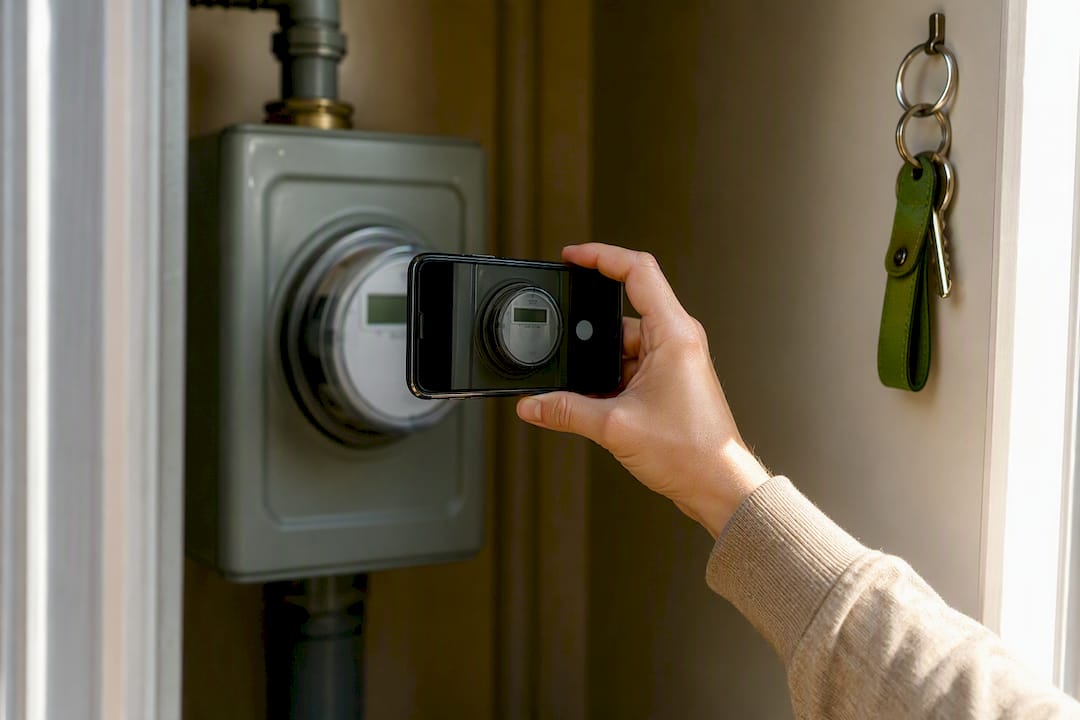
If your apartment has individual utility meters, take a photo of the readings the day you leave. It sounds excessive until a landlord tries to bill you for a neighbor's water usage. Keep every document, from the signed lease to the final walkthrough notes, in one folder. You'll want it if a deposit dispute drags into a phone call three weeks after you've already moved.
Room-by-Room Move-In Checklist for Your New Apartment
The first hour in a new apartment sets the tone for everything after it. Before boxes even come off the truck, check the basics: do the locks work, are the smoke and carbon monoxide detectors installed and functioning, are the breakers labeled, and does water run clear from every tap. These are also the exact conditions you'll want photographed immediately, since a move-in walkthrough with photos protects you the same way a move-out walkthrough does: it establishes what was already broken before you touched anything.
Kitchen. Run every appliance for a few minutes: stove, oven, dishwasher, refrigerator. Open every cabinet and drawer to check for pests, water damage, or leftover items from the previous tenant. Run the sink and check under it for slow leaks, and confirm the garbage disposal (if there is one) actually works.
Bedroom and living room. Measure the space before you commit to furniture placement, especially if your movers are on a tight schedule and you don't want them setting up a bed frame in the wrong spot twice. Set up the bed first; it's the item you'll be most grateful for at 11 p.m. after a full day of unpacking. Check closet doors, window locks, and screens while the room is still empty and easy to inspect.
Bathroom. Run the water in the shower and sink and watch how long it takes to warm up. Test the exhaust fan, since a broken one leads to mold faster than most people expect in a humid climate. Check the caulking and grout around the tub for gaps or discoloration, which often signal a slow leak that isn't your fault, but will be your problem if it isn't documented now.
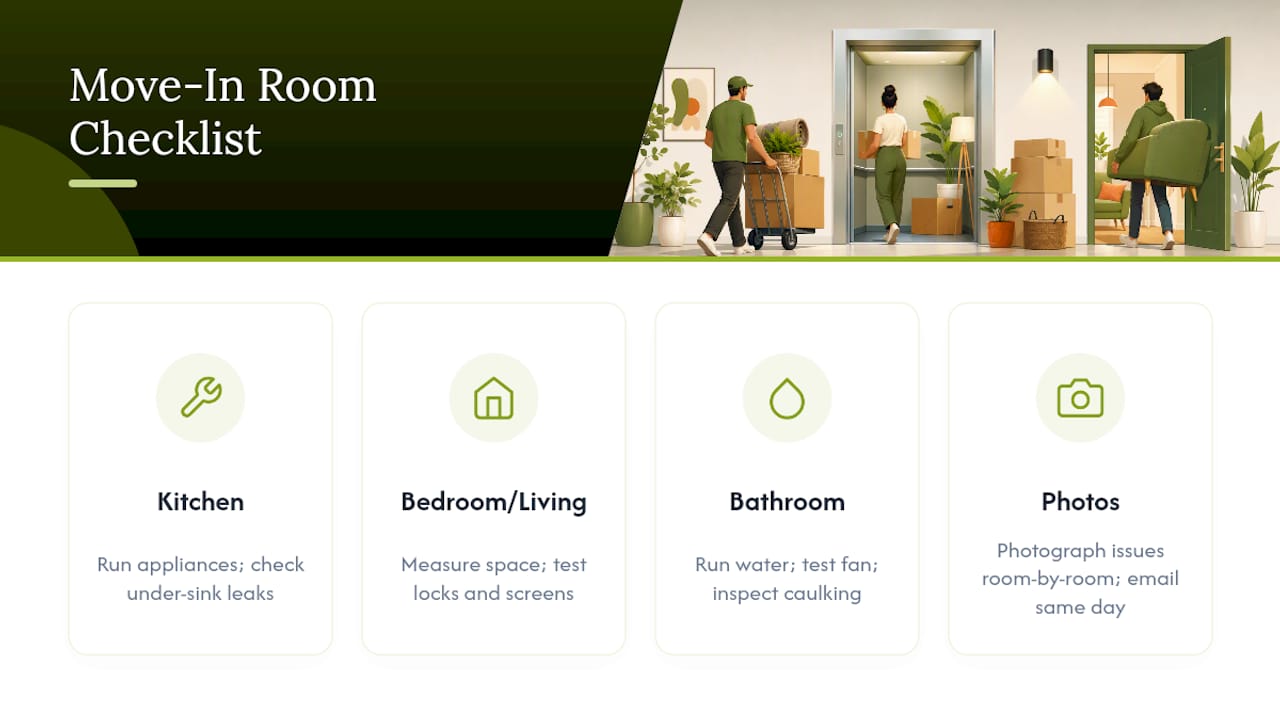
Photograph anything that looks off, room by room, before boxes pile up and obscure the walls and floors. Email those photos to your building management the same day, with a short note describing what you found. That email becomes your timestamp if a dispute ever comes up about whether damage happened before or after you moved in.
Packing Supplies, Labeling, and the Essentials Box That Saves Your First Night
You don't need to buy every box. Grocery stores and liquor stores often give away sturdy boxes for free, and some moving companies run box-return programs worth asking about before you spend money on new ones.
Once you have supplies, the labeling system matters more than the boxes themselves:
- Write the destination room and a priority level (unpack first, unpack this week, no rush) on the side of every box, not the top.
- Number each box and keep a simple list of what's inside, especially for anything fragile.
- Wrap fragile items separately and group all fragile boxes together so movers know to handle that stack with care.
- Disassemble large furniture ahead of time and bag the hardware, taped to the piece it belongs to.
- Pack heavier boxes first if you know your building has a short elevator window, since heavy items typically need to go up first, followed by boxes sorted by room, to avoid repeat trips through a tight loading schedule.
Your essentials box is the one thing that should never go in the moving truck stack with everything else. Pack it last, keep it with you, and load it with toiletries, phone chargers, a change of clothes, basic tools, toilet paper, and any medication you take daily. That box should cover you for the first 24 to 48 hours, when you're too tired to dig through ten unlabeled boxes looking for a toothbrush.
If your new apartment is smaller than your old one, or you're moving between leases with a gap, a short-term storage unit can bridge that space without forcing rushed decisions about what to keep.
Pro Tip: Pack a box labeled "Open Last" and fill it with anything you're on the fence about donating. If you haven't missed it after two weeks in the new place, you have your answer.
How Do You Handle Elevator Reservations, Parking, and Building Rules?
Apartment buildings run on rules that houses don't have, and skipping this step is the fastest way to get turned away at your own move. Before moving day, confirm the specifics directly with your building's management office, in writing if possible.
- Ask whether the building requires a reserved elevator or loading dock window, and book it as early as your lease and management allow.
- Find out whether your movers need to provide a certificate of insurance (COI), since many buildings won't allow movers past the lobby without one on file.
- Confirm the exact legal name and address the COI needs to list; a mismatch is one of the most common reasons a mover gets rejected at the door.
- Ask whether the building supplies floor and wall padding for common areas, or whether your movers are responsible for bringing their own.
- Secure any temporary parking or loading zone permits your building or city requires, and know who to call the day of your move if something's unclear.
If management is slow to respond or the policy seems vague, follow up in writing and get a specific answer before your movers show up. A verbal "should be fine" from a leasing office is not the same as a confirmed reservation.
What Should a Moving-Day Agenda Look Like?
Moving day runs smoothly when you treat it like a sequence, not a scramble. Walk through this order and you'll avoid most of the delays that turn a six-hour move into a ten-hour one.
- Confirm your movers' arrival window the night before, and have your building contact and elevator reservation confirmation ready to hand over.
- Do a final check of labeled boxes and your written inventory before the truck arrives.
- Protect hallways, doorframes, and elevator walls with padding, whether it's yours or the building's.
- Supervise loading closely: check items against your inventory and photograph anything that looks damaged before it leaves the apartment.
- Sequence the load for the elevator window; heavy furniture first, then boxes grouped by room, to minimize trips.
- Get a copy of the bill of lading and written confirmation of every service performed and its cost, standard practice for any legitimate mover.
- Handle payment and tip based on the final invoice, not a verbal estimate given weeks earlier.
- Do a final walk-through of your old apartment, checking closets, cabinets, and behind doors before you hand back the keys.
Keep every document from that day, including the bill of lading, somewhere safe. You'll want it if a piece of furniture shows up damaged and you need to file a claim.
What Comes After the Move? Utilities, Address Updates, and Your Deposit
The move isn't finished when the truck pulls away. A short list of admin tasks stands between you and feeling settled.
- Confirm your utilities and internet are active, and test major appliances the same day in case anything didn't survive the trip.
- Update your address with USPS, your bank, your employer, and any subscriptions still shipping to your old place.
- Transfer or purchase renters insurance with an effective date that starts the day you move in, not a week later.
- Unpack in stages: kitchen and bathroom first, bedroom second, everything else as time allows.
- Request your deposit return in writing once your lease's return window opens, and if a deduction seems unfair, respond with your move-out photos and receipts attached.
Most disputes get resolved faster when your documentation is organized and sent promptly, rather than pieced together after the fact from memory.
Do You Need to Tell Your Neighbors or Building Management About Your Move?
Yes, and skipping this step is one of the more avoidable ways to start off on the wrong foot in a building. A short heads-up prevents blocked hallways, annoyed neighbors, and last-minute scheduling conflicts on both ends of your move.
For your current building, notify the management office of your exact move date as soon as you've confirmed it with your movers, not just when you gave your lease notice. If your unit shares a hallway or elevator with close neighbors, a quick note or knock letting them know a moving truck will be around on a specific day goes a long way, especially in buildings with limited elevator access or narrow hallways where boxes might sit for a few minutes at a time.
For your new building, the same notification applies before you arrive. Confirm your elevator reservation and loading dock time directly with management, and ask whether they require advance notice to post in common areas or notify other residents on your floor. Some buildings have specific move-in hours, often weekdays during business hours, and showing up outside that window can mean getting turned away at the door regardless of how carefully you planned everything else.
If you're moving into a smaller building without a formal management office, a simple email or text to the building owner or your new neighbors covers the same ground. It costs you five minutes and buys goodwill you might need later, whether that's someone holding a door for you or simply not complaining about noise on a Saturday morning.
What Should You Do If Something Goes Wrong on Moving Day?
Delays and lost items happen more often than moving companies like to admit, and how you respond in the first hour matters more than the problem itself. If your movers are running late, call them directly rather than waiting and wondering. A legitimate company will give you a real update, not silence.
If your building's elevator reservation gets bumped by another tenant's move or a maintenance issue, go straight to building management rather than trying to resolve it with your movers alone. Management controls that resource, and they're the only ones who can extend your window or find an alternative, like a freight elevator on a different schedule.
Lost or damaged items are the harder problem, and this is where your documentation pays off. If you photographed items before loading and kept your written inventory, you have what you need to file a claim quickly. Contact your moving company in writing the same day you notice the issue, reference your bill of lading, and describe the item and its condition before the move. Waiting a week to report a problem makes it far easier for a company to claim the damage happened after delivery, not during transit.
If a dispute stalls, keeping every estimate, contract, and communication in your moving folder gives you a paper trail that speeds up resolution, whether you're dealing with the mover directly or escalating a claim.
Why Documentation Beats Good Intentions Every Time
Most people think a smooth move comes down to hiring the right company. It matters, but the bigger factor is whether you documented everything along the way. A moving binder or digital folder holding your lease, estimates, the certificate of insurance, and every receipt turns a "he said, she said" deposit dispute into a five-minute email with attachments.
Date-stamped photos from your walkthroughs do more work than most renters expect; they're not just for your protection, they speed up resolution when a landlord or building manager is acting in good faith too. And when a coordinated moving service handles the COI paperwork and quote negotiation directly with your building, you skip the back-and-forth that eats up your final week before the move.
— Victor
A Simpler Way to Handle Your Apartment Move
Everything in this checklist works, but it takes hours to execute well: researching movers, comparing quotes, chasing down a COI, and hoping the company you picked actually shows up on time. Some moving services handle the legwork by connecting you with pre-screened, licensed, and insured movers and negotiating competitive quotes on your behalf, with binding estimates and no hidden fees.

This approach fits renters juggling a busy work schedule, anyone moving long-distance where coordinating logistics across two cities is its own job, and apartment residents dealing with strict building rules around elevator windows or insurance paperwork, as explained in how fast you can close in Miami real estate. A dedicated move coordinator handles that communication directly with your building, so you're not the one on hold with a leasing office the week of your move. If you're relocating across state lines, the long-distance moving services page explains how quote negotiation and mover matching work from start to finish. For anyone who wants the full hands-off experience, packing included, the full-service movers and packers option covers the process end to end. You can request a quote to understand what a coordinated move may cost before you commit to a date.
Sources
- Apartmentguide
- Apartment moving checklist | MoveBeacon
- Your ultimate apartment moving checklist | Lemonade
FAQ
How Far in Advance Should I Start an Apartment Moving Checklist?
Start six to eight weeks before your move date to secure your preferred moving dates and lock in building access windows. This gives you enough time to give notice, book movers, and handle the paperwork most buildings require before move day.
What Should Go in My Essentials Box?
Pack toiletries, phone chargers, a change of clothes, basic tools, and any daily medication. That box should cover your first 24 to 48 hours in the new place without needing to dig through unlabeled boxes.
Do I Need a Certificate of Insurance to Move Into My Apartment?
Some buildings require a certificate of insurance from your moving company before they'll allow access to the loading dock or elevator. Confirm the exact name and address the COI needs to list with your management office well before moving day.
How Do I Protect My Security Deposit During a Move?
Document your apartment's condition with date-stamped photos during both your move-out and move-in walkthroughs, and keep every repair and cleaning receipt. This documentation is your strongest defense if a landlord tries to withhold part of your deposit unfairly.
How Much Does Valueaddedmoving Cost?
Pricing depends on your move's distance, size, and timing, so current quotes are available directly through the site rather than as a flat rate. You can request a personalized quote through the Valueaddedmoving landing page to compare options before booking.